
Jump to:
Updates from National Association of Regional Councils
CONGRESS
The Senate is in session. The House has left for August recess.
Senate Budget Committee Holds Hearing on the Future of Electric Vehicles
The “Charging Ahead: The Future of Electric Vehicles,” hearing held by the Senate Committee on the Budget gathered experts to discuss the advancement of EV technology and infrastructure. Key testimonies, such as those from Dr. Jesse Jenkins and Ms. Britta Gross, emphasized the technological challenges and the role of government in supporting the EV market. The discussions covered the need for significant infrastructure investments, the challenges posed by China’s dominance in the EV battery market, and the broader economic and environmental implications of transitioning to electric vehicles. Coordinated policy efforts and strategic investments were highlighted as crucial for improving grid capacity and ensuring the U.S.’s competitiveness and environmental sustainability in the shift toward electrifying American cars and public transportation.
To view the witnesses’ testimonies or watch a video of the hearing, visit the hearing’s webpage.
Last Call for Appropriations Before the August Recess
While the House has already left for the August recess, the Senate still has one more week left in Washington. This Thursday, August 1, the Senate Appropriations Committee will markup the fiscal year 2025 Department of Energy (DOE)-Water, Department of Defense (DOD), Department of Labor (DOL)-Health and Human Services (HHS)-Department of Education (ED), Department of Homeland Security (DHS), and Financial Services appropriations bills. Additional legislation facing a markup in the Senate this week include the Senate Energy and Natural Resources Committee markup on S.4753, the Energy Permitting Reform Act of 2024 and the Senate HELP Committee markup of the Older Americans Act Reauthorization Act.
Upcoming Congressional Hearings to Monitor
Tax Tools for Local Economic Development
Tuesday, July 30 | 10:00 AM ET
The Senate Finance Committee will hold a hearing to discuss tax tools for local economic development.
To view the witnesses’ testimonies and a video of the hearing once available, click here.
Long-Term Economic Benefits and Impacts from Federal Infrastructure and Public Transportation Investment
Wednesday, July 31 | 10:00 AM ET
The Senate Banking, Housing, and Urban Affairs Committee will hold a hearing examining the long-term economic benefits and impacts from federal infrastructure and public transportation investment.
To view the witnesses’ testimonies and a video of the hearing once available, click here.
Charging Ahead: The Future of Electric Vehicles
Wednesday, July 31 | 10:00 AM ET
The Senate Budget Committee will hold a hearing on the future of electric vehicles in the United States.
To view the witnesses’ testimonies and a video of the hearing once available, click here.
ADMINISTRATION
Biden-Harris Administration Proposes Ban on Family Seating Fees Charged by Airlines
The Biden-Harris Administration has proposed a new rule through the Department of Transportation (DOT) positioned to ban airlines from charging fees for seating families together. This rule, part of a broader government effort to eliminate unfair pricing, would require airlines to offer adjacent seating for parents and young children without additional charges, potentially saving families significant amounts per trip. The proposal mandates that airlines provide adjacent family seating at the time of booking if available, and includes various provisions to ensure compliance, such as penalties for violations and requirements for airlines to offer refunds or rebooking options if seating together isn’t possible. Additionally, the rule seeks to make this family seating policy transparent and integrated into the ticket purchasing process, emphasizing that family seating is a basic service that should not incur additional fees. This initiative reflects the administration’s ongoing commitment to consumer protections and making air travel more family-friendly and affordable.
FAA Announces Over $427M in Grants to Improve Airports
The Biden-Harris Administration, through the Federal Aviation Administration (FAA), has allocated over $427 million in grants for improvements at 245 airports across 39 states and American Samoa. This funding, part of the Airport Improvement Program’s third round, will support various projects including runway repairs, taxiway enhancements, as well as upgrades to airport facilities and equipment. U.S. Secretary Pete Buttigieg highlighted that these projects aim to modernize the aviation infrastructure, improving safety, resilience, and efficiency for a better travel experience for Americans. Notable projects receiving funds include major updates in Alabama, American Samoa, and other locations across the U.S. This initiative reflects broader efforts within the administration to strengthen national infrastructure and facilitate long-term benefits for passengers and airport operations.
Click here to view an interactive map with all the grants.
FRA Releases Final Accident Report on Norfolk Southern Derailment in East Palestine
The Federal Railroad Administration (FRA) released its final report on the Norfolk Southern derailment in East Palestine, Ohio, aligning with the National Transportation Safety Board’s findings. The report, part of a swift response from the U.S. Department of Transportation, identified the overheating of a roller bearing as the primary cause. The FRA also highlighted inadequate safety practices and staffing issues at Norfolk Southern, particularly in handling critical alerts from hot box detectors. The report underscores the need for Congressional action to improve rail safety standards. Additionally, the use of outdated DOT 111 tank cars exacerbated the severity of the accident. This incident has spurred a reassessment of safety practices across the rail industry.
NTIA Opens Applications for $1B Digital Inclusion Grant Program
The Biden-Harris Administration, through the Department of Commerce’s Nation Telecommunications and Information Administration (NTIA), has announced the opening of applications for nearly $1 billion in grants as part of the Digital Equity Act’s $1.25 billion Competitive Grant Program. This initiative, integral to the “Internet for All” strategy, ensures that diverse communities across the U.S. can access necessary digital tools and skills. The funding will support city and county governments, Native entities, nonprofits, educational agencies, and workforce development organizations in improving digital connectivity and capabilities. The grants focus on promoting broad digital participation, which is critical for boosting the economy and guaranteeing all Americans can thrive in a digitally driven society. Applications are due in late 2024, with awards expected to be distributed starting in the winter.
EPA Announcing over $325M Through Community Change Grants Program
The U.S. Environmental Protection Agency (EPA) is announcing more than $325 million in funding for 21 initial selections to help disadvantaged communities tackle environmental and climate justice challenges through the Community Change Grants Program. The program, enacted through the Infrastructure Investment and Jobs Act (IIJA) is the largest investment in environmental and climate justice in EPA’s history. The investments EPA will be making through the Community Change Grants are intended to achieve the following goals:
- Provide resources to communities facing disproportionate amounts of legacy pollution, climate change impacts, and generations of disinvestment to support community-driven projects that result in lasting positive change on the ground.
- Invest in strong collaborations between partners working with and for communities with environmental and climate justice concerns.
- Ensure communities can access federal, and other, resources to advance environmental and climate justice goals.
- Fund community-driven efforts to catalyze meaningful positive progress on addressing environmental and climate challenges.
- Strengthen communities’ decision-making power through meaningful engagement in governmental processes that impact them.
The Community Change Grants Program Notice of Funding Opportunity (NOFO) is accepting applications through November 21, 2024.
USDA Announces $163M to Support Clean Energy Projects
On July 26, 2024, U.S. Secretary of Agriculture Tom Vilsack announced a $163 million investment through the Rural Energy for America Program to support 338 clean energy projects across 39 states and Guam. This initiative, fueled by the Inflation Reduction Act aims to lower energy costs and foster job creation in rural areas. The funds will be allocated in the form of loans, grants, and technical assistance, promoting renewable energy and energy efficiency among rural small businesses and farmers. The projects, which include solar arrays and energy-efficient equipment, are expected to significantly reduce energy expenses and contribute to economic prosperity in rural communities. This effort marks the Biden-Harris Administration’s commitment to expanding clean energy access and addressing climate change while bolstering rural economies.
EDA Announces $25M Good Jobs Challenge NOFO
The U.S. Department of Commerce, under the Biden-Harris Administration, announced a new $25 million funding opportunity through the Economic Development Administration (EDA) for the Good Jobs Challenge. This measure, a continuation of the efforts initiated by the American Rescue Plan, looks to support locally led workforce training programs that provide access to high-quality jobs without requiring a four-year college degree. The funding will focus on key technology sectors such as advanced energy, biotechnology, robotics, and semiconductors, aligning with the goals of the CHIPS and Science Act of 2022. The EDA plans to distribute 5-8 awards ranging from $1 million to $8 million by winter 2024, prioritizing applications that incorporate worker input and cater to those impacted by technological advancements. This program shows the administration’s commitment to strengthening U.S. economic competitiveness while addressing workforce needs in essential industries.
Biden-Harris Administration Announces New AI Actions
Last October, President Biden issued an executive order to position the United States as a leader in artificial intelligence (AI), addressing its potential benefits and associated risks. This order is built on previous commitments from leading U.S. AI companies, including a new signatory, Apple, affirming their commitment to responsible AI development. Federal agencies have completed the 270-day milestone actions outlined in the order, which included the release of new safety guidelines by the AI Safety Institute and frameworks by the National Institute of Standards and Technology for managing AI risks. These actions play a larger role in establishing AI testbeds, protecting against digital threats to national security, and embedding the role of AI in economic sectors critical to American competitiveness. The initiative also stresses increasing AI capabilities within the federal government, demonstrated by the AI Talent Surge, which has brought numerous professionals into critical roles. Additionally, the administration has taken steps to bolster U.S. leadership on AI internationally, including developing AI safety institutes and advocating for responsible AI use in military applications globally.
HUD Announces $19M in New Housing Investments
The U.S. Department of Housing and Urban Development (HUD) has allocated $19 million in grants and loans to 32 properties through its Green and Resilient Retrofit Program. This funding will facilitate energy efficiency and climate resilience improvements in over 4,260 homes for low-income individuals, families, and seniors. Announced by HUD’s Deputy Assistant Secretary for Multifamily Housing Programs, Ethan Handelman, at press conference in Detroit, this initiative is part of a larger effort, with total program funding now exceeding $773 million, impacting 20,752 homes. The projects, spread across 18 states, look to improve living conditions by integrating renewable energy sources, improving indoor air quality, and making homes more resilient to climate-related risks.
HUD Launches New $175M Opportunity to Build Housing
The U.S. Department of Housing and Urban Development (HUD) has introduced a new $175 million funding opportunity addressing homelessness through the construction, acquisition, or rehabilitation of permanent supportive housing (PSH). This initiative, part of the Continuum of Care (CoC) program, targets communities across the U.S., with a special allocation of $65 million for states with smaller populations. The PSH will provide stable, non-time-limited housing coupled with supportive services for individuals and families experiencing homelessness, particularly those with disabilities. Announced by HUD Acting Secretary Adrianne Todman, the funding is designed to foster independent living and improve life outcomes. Furthermore, up to 20% of each grant can be used for additional CoC Program activities, including operating costs and services, improving overall effectiveness and sustainability of the projects. This effort aligns with the administration’s broader strategy to significantly boost the housing supply and ensure effective support for those at risk of or experiencing homelessness.
OTHER FEDERAL NEWS
Economic Growth Quickens, Rising at 2.8% Rate in Second Quarter
This past Thursday, the Wall Street Journal reported the U.S. economy experienced acceleration in the second quarter of 2024, with a GDP growth rate of 2.8%, up from 1.4% in the previous quarter and surpassing economist expectations of 2.1%. This growth was driven by robust consumer spending and increased business investment in equipment and inventory, alongside a cooling of inflation rates. The Federal Reserve will likely maintain stable interest rates in the upcoming meeting, but they’re considering a rate cut in September if the inflation decline persists. Despite this positive trend, certain sectors like airlines and automotive reported weaker performances, reflecting a mixed economic presumption. Consumer mood remains cautious, influenced by high prices and borrowing costs, affecting spending behavior and slowing down the traditionally busy spring home-buying season.
White House Looks to Safeguard Groundwater Supplies as Aquifers Decline Nationwide
An article from Route Fifty reports that the White House is taking proactive measures to address the depletion of aquifers due to overconsumption and contamination from agricultural and industrial activities. At a workshop organized by the President’s Council of Advisors on Science and Technology, experts discussed the federal government’s role in supporting local efforts to manage and sustain groundwater resources effectively. The council is considering recommendations that include creating a national inventory of aquifers, improving the tracking of groundwater stewardship into the mission of relevant federal agencies. These steps work to facilitate local restoration and sustainable usage plans for groundwater, possibly supported by federal incentives.
Updates from federal delegation
SENATOR BENNET
Bennet, Heinrich, Merkley, Caraveo, Vasquez Welcome $400 Million to Combat Historic Western Drought
USDA’s New Water Savings Commodity Program Follows Call from Colorado, New Mexico, California, Oregon, Arizona, Nevada, & Montana Lawmakers in April
Washington, D.C. — U.S. Senators Michael Bennet (D-Colo.), Martin Heinrich (D-N.M.), and Jeff Merkley (D-Oregon) and U.S. Representatives Yadira Caraveo (D-Colo.) and Gabe Vasquez (D-N.M.) welcomed the U.S. Department of Agriculture’s (USDA) announcement of $400 million to address drought through investments at the irrigation district scale in 12 states across the American West.
“Family farmers, water users, and communities across the American West are facing the effects of a 1200-year drought and a changing climate. This is a five-alarm fire, and Washington ought to treat it that way,” said Bennet. “With this investment, the Biden administration answered our call to bring resources to bear that will help producers innovate and become more resilient to drought. I’m grateful for Secretary Vilsack’s leadership in delivering this relief for Colorado and the West.”
“New Mexicans are on the front lines of increasingly extreme weather events driven by climate change, including prolonged drought and long-term aridification. We need better tools to stay prepared,” said Heinrich, Chair of the Senate Appropriations Subcommittee that oversees USDA. “I applaud the USDA for heeding our calls to invest in new, innovative resources for our agricultural producers and communities to strengthen water security and climate resilience.”
“As climate chaos fuels long-term drought in Oregon and across the American West, the federal government must use all the resources at its disposal to address this ongoing crisis,” said Merkley. “My colleagues and I urged the administration to take action earlier this year, and I applaud the USDA for creating this new program to fund innovative water solutions. This is a much-needed step forward to build a stronger, more resilient future for the West’s economy and environment.”
“I’m very excited the bicameral effort I helped lead in April urging USDA for Western drought investments paid off. This new Water Savings Commodity Program and federal investments will be life changing for Colorado — giving our communities the resources and protections they need,” said Caraveo.
“New Mexicans understand the critical impact that long-term droughts have on our communities and agricultural industries. After calling on the USDA for additional resources, I’m now proud to welcome this $400 million investment to address droughts and improve water conservation efforts,” said Vasquez. “This funding will help ensure a more sustainable, resilient future for the American West.”
Producers who participate in USDA’s Water Saving Commodity Program will receive payments for voluntarily reducing water consumption while maintaining commodity production. This funding will help conserve up to 50,000 acre-feet in water use across 250,000 acres of irrigated land in production, while expanding and creating new, sustainable market opportunities. The new program, coupled with investments from the Western Water Framework, will support innovative measures for water conservation while building resilience for long-term agricultural production in Colorado and the West.
The Palisade Irrigation District was selected for the innovative funding opportunity in Colorado.
In April, Bennet, Heinrich, Merkley, Caraveo, and Vasquez led 26 of their colleagues representing Western states in a letter urging the Biden administration to make further investments to address long-term drought caused by climate change. The lawmakers applaud the administration’s previous and ongoing efforts to combat drought in the American West – including through the Western Water and Working Lands Framework and by opening up Inflation Reduction Act funding for additional climate-smart agriculture practices – and called for further action to address Western drought through investments in upstream watershed-scale projects, water forecasting, water conservation, and watershed restoration.
ICYMI: On Senate Floor, Bennet Delivers Impassioned Speech Ahead of Senate Child Tax Credit Vote
Washington, D.C. — Today, Colorado U.S. Senator Michael Bennet delivered a speech on the Senate floor emphasizing the importance of the Child Tax Credit to cut child poverty ahead of Thursday’s vote on the Wyden-Smith Tax Relief for American Workers and Families Act.
“We’re the first generation of Americans, the people in this Senate, that are actually leaving less opportunity, not more, to our kids and our grandkids. That has never happened before in American history… finally, we have a bill in front of us that doesn’t just cut taxes for the biggest corporations and the wealthiest people in the country, but actually cuts taxes for working people,” said Bennet.
The Wyden-Smith Tax Relief for American Workers and Families Act would raise the cap on the child tax credit for low-income families and make them eligible for a full $2,000 credit, help reduce housing costs by increasing the supply of affordable housing, and raise the tax deduction small businesses can take on research and development. The House passed the bill on a bipartisan basis on January 31st with 357 votes in favor, 70 votes opposed.
Video of Bennet’s remarks is available HERE.
Bennet, Cornyn Introduce Bipartisan Bill to Boost Innovation in Education
Bipartisan Legislation Would Replicate Success of DARPA Model to Invest in High-Risk, High-Reward Education Research
Washington, D.C. — U.S. Senators Michael Bennet (D-Colo.) and John Cornyn (R-Texas) introduced the New Essential Education Discoveries (NEED) Act to help schools and colleges make advancements in teaching and learning. The legislation would create a national center that advances high-risk, high-reward education research projects, similar to the model employed by the Defense Advanced Research Projects Agency (DARPA).
“As a former school superintendent, I know our teachers are doing everything they can to overcome today’s educational challenges – especially as COVID, social media, and nationwide mental health crisis have made their jobs more difficult than ever. They need new tools to overcome these obstacles and educate the next generation of Americans, and Congress can help by investing in cutting-edge education research,” said Bennet. “This bipartisan bill will help schools, educators, and policy makers meet today’s education challenges and make necessary, data-based adjustments in the future.”
“With the opportunities and challenges of technology like artificial intelligence, we have a responsibility to develop and disseminate cutting-edge practices to bridge gaps in students’ academic readiness,” said Cornyn. “This legislation invests in education, STEM instruction, and innovative learning methods to help equip our future workforce with the resources and skills necessary to maintain America’s preeminence in the world.”
The NEED Act would create a National Center for Advanced Development in Education (NCADE) dedicated to developing and disseminating cutting-edge practices and tools – such as voice recognition software to assess emerging readiness gaps and dyslexia, and digital learning platforms – to help students recover lost learning time from the pandemic.
Specifically, the legislation would:
- Make robust investments to establish, staff, and operate NCADE;
- Require the Advanced Development Commissioner to appoint an advisory panel to guide the development and implementation of NCADE projects; and
- Conduct and disseminate the results of periodic evaluations of the effectiveness of NCADE in achieving its mission of expanding education R&D and improving teaching and learning.
The NEED Act would also improve Statewide Longitudinal Data Systems (SLDS) and help states better track students’ progress through K-12 and into the workforce while protecting the privacy of students’ education records. This data will help policymakers understand and address opportunity and achievement gaps across the country.
“Too many students across Colorado, particularly those from under-served communities, are falling behind. We need to invest in cutting-edge research to identify innovative solutions to serve these students. We also need stronger state data infrastructure so that we can measure outcomes and invest in programs that work,” said Katie Zaback, Vice President of Policy, Colorado Succeeds. “The NEED Act will address both of these needs. A new National Center for Advanced Development in Education can unlock new insights, and modernized statewide longitudinal data systems will strengthen the infrastructure that serves as the backbone for effective research and ongoing improvement.”
“Relative to many other countries, the United States spends too little on educational research and development. If we want educational policymakers and leaders to make decisions based on evidence, we need much more research on the kinds of innovations that make a difference in all children’s outcomes. Senator Bennet’s New Essential Education Discoveries (NEED) Act will provide the resources needed to accelerate innovation in teaching and learning and help close opportunity gaps,” said William Penuel, Distinguished Professor, School of Education at the University of Colorado Boulder and Director, National Center for Research in Policy and Practice.
“We have come upon an opportune moment to combine learning sciences, new and advancing technologies, and big, bold ideas to build more equitable, effective, and engaging learning opportunities for students while supporting our K-12 teachers in their important work. I thank Senator Bennet for his leadership and sponsorship of the New Essential Education Discoveries (NEED) Act, which recognizes the importance of supporting innovative, cutting-edge projects for teaching and learning just as we value innovations in health, energy, and defense,” said Sidney D’Mello, Professor, Institute of Cognitive Science at the University of Colorado Boulder, and Principal Investigator, National Science Foundation National AI institute for Student-AI Teaming.
“The NEED Act recognizes that we must address the impact of the COVID-19 pandemic on student outcomes, as well as restore America’s standing as a world leader in innovative education,” said Jean-Claude Brizard, President and CEO, Digital Promise. “It would create a DARPA-inspired National Center for Advanced Development in Education (NCADE) dedicated to developing cutting-edge practices and tools, as well as make a considerable investment in statewide longitudinal data systems. Through Digital Promise’s networks like the League of Innovative Schools, we’ve seen what can be achieved with forward-thinking initiatives in Colorado districts like Adams 12 Five Star Schools and Trinidad School District. The NEED Act will help propel the U.S. education system into the future and enable schools to make significant advances in teaching and learning.”
“From defense to transportation, nearly every sector other than education has its own version of an Advanced Research Projects Agency (ARPA),” said Dan Correa, CEO, Federation of American Scientists. “In the age of rapid developments in emerging technologies, especially artificial intelligence, this is a huge missed opportunity for education. It’s time to make an ARPA for education a reality, and the NEED Act will do that. This important legislation will also strengthen and modernize statewide longitudinal data systems, which provide the foundation for robust R&D.”
“The NEED Act would develop and enhance our education data infrastructure, providing a roadmap for decision-makers on how to give underserved students the high-quality education they need and deserve. This is especially urgent as the pandemic intensified the already pervasive racial and socio-economic disparities embedded in our nation’s schools,” said Denise Forte, President and CEO, The Education Trust. “The bill also invests in promising education research and development to put data in action to make our school systems more equitable. We urge Congress to pass this important piece of legislation.”
“Our nation’s model of schooling looks much the same today as it did a century ago, which makes it impossible to help each student reach their full potential,” said Joel Rose, Co-Founder and CEO, New Classrooms. “The NEED Act will provide a much needed federal investment in education to develop high-reward transformative solutions and bold innovative learning models that produce dramatic breakthroughs for students and teachers.”
This bill is supported by nearly 70 organizations, including: Advanced Education Research and Development Fund (AERDF), Alliance for Learning Innovation, American Association of Colleges for Teacher Education (AACTE), American Educational Research Association, American Federation of Teachers, American Psychological Association Services, Coalition for Community Schools, Colorado League of Charter Schools, Colorado Succeeds, Committee for Children, Digital Promise Global, ExcelinEd in Action, Federation of American Scientists, White House Office of Management and Budget, Lehigh University, National Alliance for Public Charter Schools, National Association of Secondary School Principals, National Center for Learning Disabilities, New Classrooms, The Education Trust, Transcend, University of Colorado – Boulder, Colorado Springs, Denver, Anschutz Campuses, and University of Denver.
The text of the bill is available HERE. A summary of the bill is available HERE.
Bennet Statement on Senate Passage of Kids Online Safety Act
Washington, D.C. — Colorado U.S. Senator Michael Bennet issued the following statement on his support and Senate passage of the Kids Online Safety Act:
“Our children and teenagers’ mental health is at an all-time low, and addictive social media platforms are driving it even lower. That’s why I voted for The Kids Online Safety Act – the first significant bill protecting children online since the advent of the internet.
“This bill takes significant steps in safeguarding our children’s mental health and privacy, but we must do more to hold tech companies accountable for their platforms’ harmful effects.
“Congress must also pass the Digital Platform Commission Act to establish a commission to regulate social media platforms. Without a permanent regulatory body, misinformation, data harvesting, and business practices that harm American children will undoubtedly continue.”
Bennet, Bipartisan, Bicameral Colleagues Condemn the Maduro Regime’s Sham Presidential Election
Washington, D.C. – Colorado U.S. Senator Michael Bennet, alongside 15 members of Congress, released the following statement regarding Venezuela’s announced election results:
“To no one’s surprise, dictator Nicolás Maduro has once again stolen a presidential election. However, what the narco-regime will never steal is the Venezuelan people’s desire to return to democracy and live in freedom after decades of tyranny. We must prioritize uniting the free world in rejecting these sham election results and securing the release of the more than 300 Venezuelans that remain arbitrarily detained in torture centers as political prisoners,” said Bennet and the lawmakers. “The Maduro dictatorship is experiencing an internal fracture, and members of the dictatorship know their status quo, which is filled with incompetence, is no longer sustainable. There is massive discontent in the streets of Venezuela, and everyday citizens have stood in support of opposition leaders María Corina Machado and Edmundo Gonzalez. Let there be no doubt: the countries and international organizations backing this fraud of unimaginable proportions must be held accountable, as should members of the narco-regime and its ‘National Electoral Council’.”
In 2019, Bennet urged the Trump administration to designate Venezuela for Temporary Protected Status (TPS) to ensure that Venezuelan nationals present in the United States were not forced to return to their home country at this time given the deteriorating situation caused by the illegitimate regime of Nicolás Maduro. Last year, Bennet called on the Biden administration to extend the eligibility date for TPS for Venezuelan nationals, given widespread violence, political persecution, food and medicine shortages, and other systemic collapses in Venezuela.
In addition to Bennet, U.S. Senators Marco Rubio (R-Fla.), Bill Cassidy (R-La.), John Kennedy (R-La.), Peter Welch (D-Vt.), Rick Scott (R-Fla.), Pete Ricketts (R-Neb.), John Cornyn (R-Texas), Tim Scott (R-S.C.) and eight members of the U.S. House of Representatives also signed this letter.
Bennet, Colleagues Call for Expedited Medical Evacuations of Children from Gaza
Washington, D.C. – Colorado U.S. Senator Michael Bennet, alongside 13 of his Senate colleagues, urged Ambassador of Israel to the United States Michael Herzog and Ambassador of Egypt to the United States Motaz Zahran to ensure Palestinian children who are critically ill or injured can leave Gaza safely to seek medical treatment, and increase access to life-saving medical treatments in Gaza.
“While people disagree about the war in Gaza, everyone should agree that no government should prevent injured children access to potentially life-saving medical care. Rather, governments should be doing everything possible to assist in this situation,” said Bennet and the senators.
“We have called on our own government to do its part in facilitating safe passage for these children. Our goal is to cooperate with your governments, consistent with your security concerns, to maximize safe passage and increase access to life-saving medical treatment for children in need. We understand some progress has been made, with a number of children in need of cancer treatment being moved out of Gaza through the Kerem Shalom crossing, in cooperation with the World Health Organization,” continued the senators. “We are encouraged by this development as a very positive first step. We must all treat the welfare of children in Gaza as an urgent humanitarian priority and work together to prevent further suffering.”
The senators also requested meetings with the Ambassadors to discuss the facilitation of safe passage for more children and their accompanying parent or caregiver to ensure their access to necessary medical treatment.
Bennet previously urged the Biden administration to continue working with allies and partners to expedite the delivery of humanitarian aid to civilians in Gaza by increasing access points for aid into Gaza, distributing adequate fuel to hospitals, and ensuring the safe delivery of humanitarian aid.
Bennet also traveled to the West Bank, Israel, and Jordan earlier this year. In meetings with Israeli, Palestinian, and Jordanian leaders, he underscored that degrading Hamas’ military capabilities, fighting for release of hostages held by Hamas in Gaza, and protecting and delivering aid to Palestinian civilians cannot be mutually exclusive.
In addition to Bennet, U.S. Senators Peter Welch (D-Vt.), Chris Van Hollen (D-Md.), Mazie Hirono (D-Hawaii), Tina Smith (D-Minn.), Tammy Duckworth (D-Ill.), Amy Klobuchar (D-Minn.), Jeff Merkley (D-Ore.), Tim Kaine (D-Va.), Elizabeth Warren (D-Mass.), Cory Booker (D-N.J.), Ed Markey (D-Mass.), Dick Durbin (D-Ill.), and Brian Schatz (D-Hawaii) also signed the letter.
The text of the letter is available HERE and below.
Dear Ambassador Herzog and Ambassador Zahran,
We write to convey our shared concern with the situation facing critically ill and injured Palestinian children whose medical and surgical needs can only be met with safe passage out of Gaza to neighboring countries where treatment is available.
While people disagree about the war in Gaza, everyone should agree that no government should prevent injured children access to potentially life-saving medical care. Rather, governments should be doing everything possible to assist in this situation.
We have called on our own government to do its part in facilitating safe passage for these children. Our goal is to cooperate with your governments, consistent with your security concerns, to maximize safe passage and increase access to life-saving medical treatment for children in need. We understand some progress has been made, with a number of children in need of cancer treatment being moved out of Gaza through the Kerem Shalom crossing, in cooperation with the World Health Organization. We are encouraged by this development as a very positive first step. We must all treat the welfare of children in Gaza as an urgent humanitarian priority and work together to prevent further suffering.
We request an opportunity to meet with you for further discussion of how we can work together to facilitate safe passage for more children and their accompanying parent or caregiver to have access to the medical treatment they desperately need and is available if passage is allowed.
Thank you for your consideration.
Sincerely,
SENATOR HICKENLOOPER
Hickenlooper, Colleagues Introduce Bill to Fix SCOTUS Decision Giving Presidents Immunity for Crimes
Legislation comes on the heels of the Supreme Court ruling that presidents are above the law and immune from criminal prosecution for official actions
WASHINGTON – Today, U.S. Senator John Hickenlooper joined 34 of his Senate colleagues in introducing the No Kings Act, which would reaffirm that presidents and vice presidents do not have immunity for actions that violate federal criminal law and clarify that Congress, not the Supreme Court, determines to whom federal criminal laws may be applied.
“No American is above the law. Our founders built our democracy on that idea and we have to make clear it applies to everyone,” said Hickenlooper.
The legislation follows the recent decision in Trump v. United States, in which the Supreme Court ruled that a former president is entitled to immunity from criminal prosecution for official actions undertaken while president.
Specifically, the No Kings Act would:
- Reaffirm that Presidents and Vice Presidents do not have immunity for actions that violate U.S. criminal law: No president or vice president (former or sitting) would be entitled to immunity from criminal prosecution for actions that violate the criminal laws of the United States. The bill would clarify that Congress, not the Supreme Court, determines to whom federal criminal laws may be applied.
- Remove the Supreme Court’s appellate jurisdiction for all actions challenging the constitutionality of this legislation: The bill would allow presidents and vice presidents to challenge the constitutionality of the No Kings Act in the United States District Court for the District of Columbia. Any appeal would be handled by the United States Court of Appeals for the District of Columbia Circuit. Using the Exceptions Clause of Article III of the Constitution, Congress would preclude the Supreme Court from hearing any appeals to these challenges. It would further remove the Supreme Court’s appellate jurisdiction to interfere with any criminal proceedings involving presidents or vice presidents on the basis that an alleged criminal act was an official action.
- Establish additional jurisdictional and procedural guardrails: The bill would allow the United States to bring criminal actions against a president or vice president in any applicable district court or the United States District Court for the District of Columbia. It would also create a presumption of constitutionality for the No Kings Act unless a party establishes its unconstitutionality with clear and convincing evidence. Lastly, the bill would create statutes of limitations of 180 days for facial constitutional challenges and 90 days for as-applied constitutional challenges.
For full bill text, click HERE. For a one pager on the bill, click HERE.
Across American history, Congress has exercised its authority to legislate on constitutional matters. From civil rights to religion to regulating elections, Congress has often enacted federal statutes directly contravening constitutional decisions from the Supreme Court when lawmakers believed the Court misapplied the Constitution. A summary of Congress’s history of legislating constitutional issues can be found here.
Hickenlooper, Warren, Whitehouse Again Urge Fed to Cut Interest Rates
Hickenlooper has called on the Fed five times since October 2022 to maintain or cut interest rates while high rates undermine American families and small businesses
Senators: “We urge you to make monetary policy in the interest of the American public, not a particular political party.”
WASHINGTON – U.S. Senator John Hickenlooper, Elizabeth Warren, and Sheldon Whitehouse sent a letter to Federal Reserve Chair Jerome Powell urging a cut to interest rates at this week’s Federal Open Market Committee meeting and in advance of their September meeting. In the face of increased Republican pressure to politicize the Federal Reserve and its decisions, the economic data suggests that the federal funds rate should already be lower than it is now.
“As we wrote in June, the Fed’s high interest rates are not an effective tool to address the remaining significant drivers of inflation, such as automobile and housing costs–and high interest rates may actually be making these problems even worse,” wrote the senators.
The personal consumption expenditures (PEC) index, a key gauge for inflation, decreased for the third consecutive month in June, making a strong case for rate cuts. Additionally, while the labor market is healthy and inflation is declining, the unemployment rate increased from 3.6 percent to 4.1 percent over the last year and job openings are down 20 percent. The Wall Street Journal’s chief economics commentator argues that the unemployment rate increase may be indicative of a trend because when unemployment ticks upwards, “it tends to keep going up.” While wage growth remains strong, it has slowed in recent months, and surveys of companies’ pay plans indicate that it is likely to continue slowing into next year. Without rate cuts, the Fed risks erasing the country’s post-pandemic economic gains.
The senators continued: “Indeed, given that the data appears to clearly justify cutting rates, the failure to do so would indicate that the Fed is giving in to bullying, and is putting political considerations ahead of its dual mandate to ‘promote maximum employment and stable prices…’ Refusing to follow the economic data and succumbing to political threats would be a subversion of your mandate.”
This most recent letter comes after Hickenlooper called on the Fed multiple times to consider the negative impacts of its continued interest rate hikes on American families:
- In October 2022, Hickenlooper called on the Federal Reserve to pause rate hikes in a letter to Chair Powell
- In January 2023, Hickenlooper sent another letter to the Federal Reserve cautioning against another interest rate increase in the face of rising layoffs and reduced employment
- In January 2024, Hickenlooper and his colleagues sent a letter to Federal Reserve Chair Jerome Powell, calling on the Federal Reserve to cut interest rates and address the affordable housing crisis
- In June 2024, Hickenlooper and his colleagues sent a letter to Federal Reserve Chair Jerome Powell, urging the Fed to cut the federal interest rates that have increased housing and insurance costs for working families.
Full text of the letter is available HERE.
Hickenlooper Votes to Pass Affordable Internet Program Extension Out of Committee
With funding lapsed, additional $7 billion will keep millions of Americans connected to the internet
Legislation now heads toward a full Senate vote
WASHINGTON – Today, U.S. Senator John Hickenlooper celebrated the Commerce Committee vote to approve $7 billion in additional funding to extend the Affordable Connectivity Program (ACP) and keep millions of Americans connected to affordable high speed internet. Facing a lapse in funding, the FCC was forced to pause the program this May. Hickenlooper sits as a member of the Commerce Committee and voted to pass the bill.
“Internet access is a basic need for modern life. The ACP delivered reliable and affordable internet to millions of Americans before it expired,” said Hickenlooper. “We need to double down on our most successful programs from the Bipartisan Infrastructure Law and keep working families connected.”
The additional funding was included in the bipartisan Plan for Broadband Act, which also included increased funding for the Hickenlooper-backed Rip and Replace Program.
ACP is the largest high-speed internet affordability program in the nation’s history, created as part of the Bipartisan Infrastructure Law, which Hickenlooper helped negotiate and write as part of the G-22 group of senators. The ACP helped over 23 million households nationwide, including over 250,000 in low-income households in Colorado, save $30-75 each on their monthly internet bills.
In advance of May’s lapse in funding for the ACP, Hickenlooper called for the extension of the program and touted its success helping Coloradans save $122 million on the cost of high-speed internet service. In total, the ACP helps Colorado families save roughly $7 million each month.
The Plan for Broadband Act would also protect rural wireless networks by increasing funding for the Rip and Replace Program, which Congress created in 2020, to reimburse smaller communications providers that remove and replace insecure and risky equipment. Hickenlooper previously called for additional funding to close the $3 billion funding shortfall in the Rip and Replace program to help support digital equity, reliable public safety, and resilient wireless communications in rural Colorado. He also introduced the bipartisan Defend Our Networks Act to help address this funding shortfall and support smaller carriers in rural areas that possess more at-risk network gear.
The legislation now heads to the Senate floor for a full vote.
Hickenlooper Cheers Committee Passage of Bill to Strengthen Services for Older Americans, Expand Federal Nutrition Programs
Hickenlooper’s Nutrition Services Improvement Plan Act included in OAA Reauthorization
WASHINGTON – Today, U.S. Senator John Hickenlooper, member of the Senate Health, Education, Labor, and Pensions Committee (HELP), celebrated the committee passage of his Nutrition Services Improvement Plan Act. Hickenlooper’s bill would help congregate and home-delivered nutrition programs, like Meals on Wheels, provide healthier meals with produce from local farms. The bill passed as part of the Older Americans Act Reauthorization Act.
“Programs like Meals on Wheels are a literal lifeline for millions of older Coloradans,” said Hickenlooper. “This bill will help make those meals healthier while supporting local producers.”
Specifically, the bill would require the Government Accountability Office (GAO) to assess the feasibility of the Nutrition Services Incentive Program (NSIP), including organizations like “Meals on Wheels”, to establish partnerships with local farms to supply produce for nutritious meals. The study would also examine the potential health benefits of providing fresh produce and healthy meals to older adults who rely on these programs.
The Older Americans Act supports social and nutrition service programs for more than 11 million seniors across the country and is up for reauthorization at the end of fiscal year 2024. The Older Americans Act Reauthorization Act extends the Older Americans Act from fiscal year 2025 to 2029. In fiscal year 2023, Colorado received $22.8 million in funding from OAA for Title III Grants for State and Community Programs on Aging, $1.4 million under the Nutrition Services Incentive Program, and $390,000 under Title VII for Vulnerable Elder Rights Protection Activities.
The HELP Committee also approved an additional Hickenlooper-cosponsored provision to expand food-based medical interventions for older Americans under the OAA, the Autism Collaboration, Accountability, Research, Education, and Support Act of 2024, and the Traumatic Brain Injury Program Reauthorization Act of 2024.
The package now heads to the Senate floor for a full vote.
Bipartisan Permitting Reform Package, Including Hickenlooper-led Provisions, Passes Senate Committee
Components of Hickenlooper’s BIG WIRES Act and SPEED & Reliability Act both included
Bipartisan bill, which would speed U.S. transition to clean energy, now heads to the Senate floor
WASHINGTON – Today, U.S. Senator John Hickenlooper, member of the Senate Energy and Natural Resources Committee, celebrated committee passage of the bipartisan permitting proposal put forward by Senators Joe Manchin and John Barrasso, which includes key policies from Hickenlooper’s BIG WIRES and SPEED & Reliability Act.
The proposal aims to modernize what is all too often a decades-long timeline to build new transmission lines and energy production projects. The bill now heads to the Senate floor for a full vote.
“Red tape and outdated processes are getting in the way of economic growth and our transition to clean energy,” said Hickenlooper. “We’ve got to move with a greater sense of urgency and this is a compromise I think we can all look forward to and vote for with pride.”
Parts of the following Hickenlooper bills are included in the package:
BIG WIRES Act
Hickenlooper and Representative Peters’ BIG Wires Act would update the country’s patchwork energy transmission system by:
- Coordinating construction of an interregional transmission system.
- Establishing minimum-transfer requirements to move large amounts of energy from one U.S. grid region to another.
Manchin and Barrasso’s bipartisan permitting reform proposal requires transmission planning regions to create a strategy to connect U.S. grid regions and speed the development of new interregional transmission lines, drawing on provisions from Hickenlooper’s BIG WIRES Act.
SPEED & Reliability Act
Hickenlooper and Representative Peters’ SPEED and Reliability Act would accelerate the siting and permitting of interregional transmission lines by:
- Allowing individual transmission lines to be deemed as “national interest high-impact transmission facilities.”
- Requiring the Federal Energy Regulatory Commission (FERC) to conduct a single environmental review for these transmission lines, rather than requiring duplicative reviews by FERC and the Department of Energy.
Manchin and Barrasso’s bipartisan permitting reform proposal streamlines permitting for interstate electric transmission lines by empowering the Federal Energy Regulatory Commission to site transmission lines after one year if they meet certain criteria and by removing duplicative environmental reviews for such lines, just like the SPEED & Reliability Act.
Currently it takes a decade or more to site, permit, and construct essential energy infrastructure like new transmission lines and new energy production like wind and geothermal projects.
Chairman Manchin and Ranking Member Barrasso’s bipartisan permitting reform bill would streamline the review process for crucial energy projects and interregional transmission lines. It comes at a time when the American energy grid suffers from a lack of true cross-country connection and households are increasingly vulnerable to natural disasters and high energy prices.
Full video of the hearing is available HERE.
Full text of the bill is available HERE.
Hickenlooper AI Bill & Six Other Hick Bills Pass Senate Committee, All Bipartisan
Seven of Hickenlooper’s bills now go to a full Senate vote
WASHINGTON – Today, U.S. Senator John Hickenlooper, member of the Senate Commerce, Science and Transportation Committee, celebrated committee passage of seven of his bipartisan pieces of legislation, including his VET AI Act. All seven bills now head to the Senate floor for a full vote.
“AI has enormous potential to boost American innovation. But without sensible guardrails or standards, it’s the Wild West out there,” said Hickenlooper. “Passing bipartisan AI legislation will significantly benefit American consumers, workers, and businesses.”
Hickenlooper led and cosponsored several artificial intelligence (AI) related bills that passed out of the Commerce Committee today, including his bipartisan Validation and Evaluation for Trustworthy Artificial Intelligence (VET AI) Act. Hickenlooper’s VET AI Act directs the National Institute of Standards and Technology (NIST) to work with federal agencies and stakeholders across industry, academia, and civil society to develop detailed specifications, guidelines, and recommendations for third-party evaluators to work with AI companies to provide robust independent external assurance and verification of how their AI systems are developed and tested.
Hickenlooper cosponsors four other bipartisan AI-related bills that passed out of the Commerce Committee today that will work to stop AI deepfakes and increase the transparency and safety of AI systems for American consumers:
- TAKE IT DOWN Act: criminalizes the publication of non-consensual, intimate imagery (NCII), including AI-generated “deepfake pornography”, on social media and other online sites, and requires social media companies to have procedures to remove content upon notification from a victim.
- Future of AI Innovation Act: authorizes the U.S. AI Safety Institute to take steps to accelerate groundbreaking AI innovation, develop governance standards, and promote partnerships between government, business, and academia to advance AI research.
- AI Research Innovation and Accountability (ARIA) Act: establishes a framework to bolster innovation while bringing greater transparency, accountability, and security to the development and operation of the highest-impact applications of AI.
- Promoting U.S. Leadership in Standards Act of 2024: aims to improve visibility into standards setting related to AI and emerging technologies and increase U.S. participation in these critical activities.
Hickenlooper’s NET Act, which strengthens our broadband supply chains to ensure an on-time rollout of federal broadband programs, and Hickenlooper’s American Music Tourism Act, which supports and increases music tourism to attract domestic and international visitors to music venues nationwide, also passed out of the Commerce Committee today.
All seven bills now head to the Senate floor for a full vote. For full video of the hearing, click HERE.
Hickenlooper Cheers Senate Passage of Bipartisan Kids Online Safety and Privacy Act
Legislation would protect kids against online risks and prioritize well-being on social media
WASHINGTON – Today, U.S. Senator John Hickenlooper, Chair of the Senate Commerce Committee’s Subcommittee on Consumer Protection, Product Safety, and Data Security, celebrated the Senate passage of the bipartisan online Kids Online Safety and Privacy Act, which will protect children from harmful content online and hold social media companies accountable. The legislation combines the Hickenlooper-cosponsored Kids Online Safety Act (KOSA) and the Children and Teens Online Privacy Protection Act (COPPA 2.0), both of which Hickenlooper helped pass out of the Commerce Committee.
“Social media companies peddle addictive algorithms that put profits over our kids’ mental health. We have to hold these platforms accountable to protect our children online,” said Hickenlooper.
The Kids Online Safety and Privacy Act provides young people and parents with the tools, safeguards, and transparency they need to protect against online harms. The bill requires social media platforms to put the well-being of children first by preventing specific harms to minors and ensuring an online environment that is safe by default. The legislation requires independent audits by experts to ensure that social media platforms are taking meaningful steps to address risks to kids and research by the National Academy of Sciences into the risk of harms to minors by the use of social media.
The Kids Online Safety and Privacy Act:
- Requires that social media platforms provide minors with options to protect their information, disable addictive product features, and opt out of algorithmic recommendations. Platforms would be required to enable the strongest settings by default.
- Gives parents new controls to help support their children and identify harmful behaviors, and provides parents and children with a dedicated channel to report harms to kids to the platform.
- Creates a responsibility for social media platforms to prevent and mitigate specific harms to minors, such as promotion of suicide, eating disorders, substance abuse, sexual exploitation, and unlawful products for minors (e.g. gambling and alcohol).
- Requires social media platforms to perform an annual independent audit that assesses the risks to minors, their compliance with this legislation, and whether the platform is taking meaningful steps to prevent those harms.
- Directs the National Academy of Sciences to conduct studies regarding harms to the safety and well-being of minors by use of social media.
The one-page summary of the bills can be found HERE, the section-by-section summary can be found HERE, and the full text of the Senate bill can be found HERE.
The underlying Kids Online Safety Act has attracted 73 bipartisan cosponsors in the Senate and is supported by hundreds of advocacy and technology groups, including Common Sense Media, American Psychological Association, American Academy of Pediatrics, American Compass, Eating Disorders Coalition, Fairplay, Mental Health America, and Digital Progress Institute.
Previously, Hickenlooper introduced the Kids Online Safety Act alongside 27 colleagues in May 2023 and helped vote the legislation out of the Senate Commerce Committee last July.
The Children and Teens Online Privacy Protection Act (COPPA 2.0) will update the existing protections to expand privacy protections for children under the age of 17 years old, ban targeted advertising to kids and teens, and create an “eraser button” for parents and kids to control and delete personal information. Current law only protects the privacy of children 12 years or younger.
Hickenlooper continues to urge Congress to pass bipartisan and comprehensive privacy legislation that would extend data privacy protections to individuals of all ages.
The bill now heads to the U.S. House of Representatives next and then President Biden’s desk for final signature.
Hickenlooper, Marshall Introduce Bipartisan Bill to Expand Access to Capital for Small Businesses
Legislation will help rural small businesses access long-term capital for growth and job creation
WASHINGTON – U.S. Senators John Hickenlooper and Roger Marshall introduced the bipartisan, bicameral Investing in All of America Act of 2024 to increase capital available to small businesses. Specifically, the bill would strengthen the Small Business Investment Company (SBIC) Program to include inflation adjustments and encourage further investments in rural and low-income communities and national defense industries.
“Small businesses are the engine of our economy. But they often struggle to get the capital they need to create jobs. Our bipartisan bill will help small businesses in rural and low-income communities flourish,” said Hickenlooper.
“Access to capital is crucial for businesses, yet rural communities across Kansas are finding it increasingly difficult to obtain,” Marshall said. “Excluding investments in rural communities from counting towards the maximum amount of debt SBICs can take will encourage more investment in underserved areas without costing taxpayers a dollar.”
For more than 60 years, SBICs have been providing capital to American small businesses to help them expand and create jobs. SBICs are privately owned companies that are licensed and regulated by the Small Business Administration (SBA). SBICs raise private capital that is then matched with leverage by the SBA. SBICs then deploy their private funds, along with the SBA-guaranteed funding, to invest directly in small businesses. The SBIC program operates at a zero-subsidy cost to the American taxpayer. Though the SBIC Program has been successful in responsibly deploying capital to small businesses, recent studies have shown that less than 20% of SBIC investment reaches low-middle income communities – the Investing in All of America Act of 2024 seeks to encourage the deployment of more capital in these areas.
Over the past ten years, SBICs have invested $58 billion in more than 11,300 U.S. small businesses across the country with 21% of the businesses located in Low-to-Moderate Income (LMI) areas. SBICs have invested $952.2 million in Colorado small businesses since 2019, with $157.8 million invested in fiscal year 2023 alone.
SBICs can access low-cost leverage up to two times the private capital they raise which they invest in U.S. small businesses. The amount of leverage is capped at $175 million for a single SBIC licensee and $350 for multiple licenses under common control, but these leverage caps have not been adjusted since 2015 and 2018, respectively.
Specifically, the Investing in All of America Act of 2024 would:
- Increase the licensee commitment levels by a factor of inflation from the last time they were adjusted in statute and adjust for inflation annually thereafter.
- Modernize bonus leverage to increase investment in rural, low-come, and national security-focused businesses. Investments eligible for bonus leverage under the legislation include smaller enterprises in low income or rural areas. These are businesses that are smaller than small businesses by definition and are in areas that are traditionally underserved.
- Make bonus leverage available for investments in small businesses that are in industries identified as critical to national security.
Companion legislation has been introduced in the House of Representatives by Representatives Dan Meuser and Hillary Scholten. The House Small Business Committee passed the legislation unanimously.
One pager on the bill is available HERE. Full bill texts are available HERE and HERE.
Hickenlooper, Marshall Introduce Bipartisan Bill to Boost Federal Nutrition Programs, Support Local Farms
WASHINGTON – U.S. Senators John Hickenlooper and Roger Marshall introduced the bipartisan Nutrition Services Improvement Plan Act to help congregate and home-delivered nutrition programs, like Meals on Wheels, provide healthier meals with produce from local farms.
“Millions of Americans rely on meals provided by the Older Americans Act. They deserve fresh, healthy meals. They deserve to know where their food is coming from,” said Hickenlooper. “This bill supports local farmers and at the same time helps seniors live healthier, longer lives.”
“I am proud to partner with my colleague and put this project into hyperdrive which aims to study how federal programs can engage with local farmers through nutrition services,” Marshall said. “Our goal is to explore the potential for a healthier, home-grown future for our communities. I have always believed that food is medicine, and this partnership provides an excellent opportunity to demonstrate this by examining the outcomes of nutritious, medically tailored meals and prescription food programs for our seniors and beyond.”
Specifically, the senators’ bill would require the Government Accountability Office (GAO) to assess the feasibility of the Nutrition Services Incentive Program (NSIP), like “Meals on Wheels”, to establish partnerships with local farms to supply produce for nutritious meals. The study would also examine the potential health benefits of providing fresh produce and healthy meals to older adults who rely on these programs.
The NSIP is authorized by the Older Americans Act, which supports social and nutrition service programs for more than 11 million seniors across the country and is up for reauthorization at the end of fiscal year 2024. In fiscal year 2023, Colorado received more than $1.42 million in support through the program.
Full text of the legislation available HERE.
SENATORS BENNET / HICKENLOOPER
Hickenlooper, Bennet Introduce Bill for Mesa County Land Transfer to Boost Rural Economy
WASHINGTON – Today, U.S. Senators John Hickenlooper and Michael Bennet introduced the Clifton Opportunities Now for Vibrant Economic Yields (CONVEY) Act to greenlight the transfer of a federal land parcel to Mesa County to support local economic development. Specifically, the bill would accelerate the sale of 31.1 acres of land near Interstate 70 in Clifton, Colorado. The parcel was previously set aside for the Bureau of Reclamation’s Grand Valley Reclamation Project, but Reclamation has indicated its intent to relinquish the 31 acres considered in the sale, and will retain the remaining 8 acres for project operations.
“Mesa County is bursting at the seams with economic development, it just needs the space to grow,” said Hickenlooper. “Our CONVEY Act will cut the bureaucratic red tape needed to accelerate this land transfer and create jobs.”
“Mesa County has made significant strides to secure a vibrant future for Clifton,” said Bennet. “I’m glad to support this agreement between the County and Bureau of Land Management as one more step towards prosperity for the community.”
“We are grateful to Senator Hickenlooper and Senator Bennet for introducing the CONVEY Act. Economic development in the Clifton area is vital for our community to thrive, and the CONVEY Act will create opportunities to expand our local workforce and strengthen a new generation of entrepreneurs and innovators in Mesa County. We are thankful for this partnership that will streamline this process to benefit all of Mesa County,” said the Mesa County commissioners in a joint statement.
The Bureau of Land Management (BLM), which is responsible for federal land transfers, supports the Mesa County transfer and has begun the National Environmental Policy Act (NEPA) process needed to finalize the process. The CONVEY Act would accelerate the sale and require Mesa County to pay fair market value for the land.
Map of the proposed lands to be transferred available HERE.
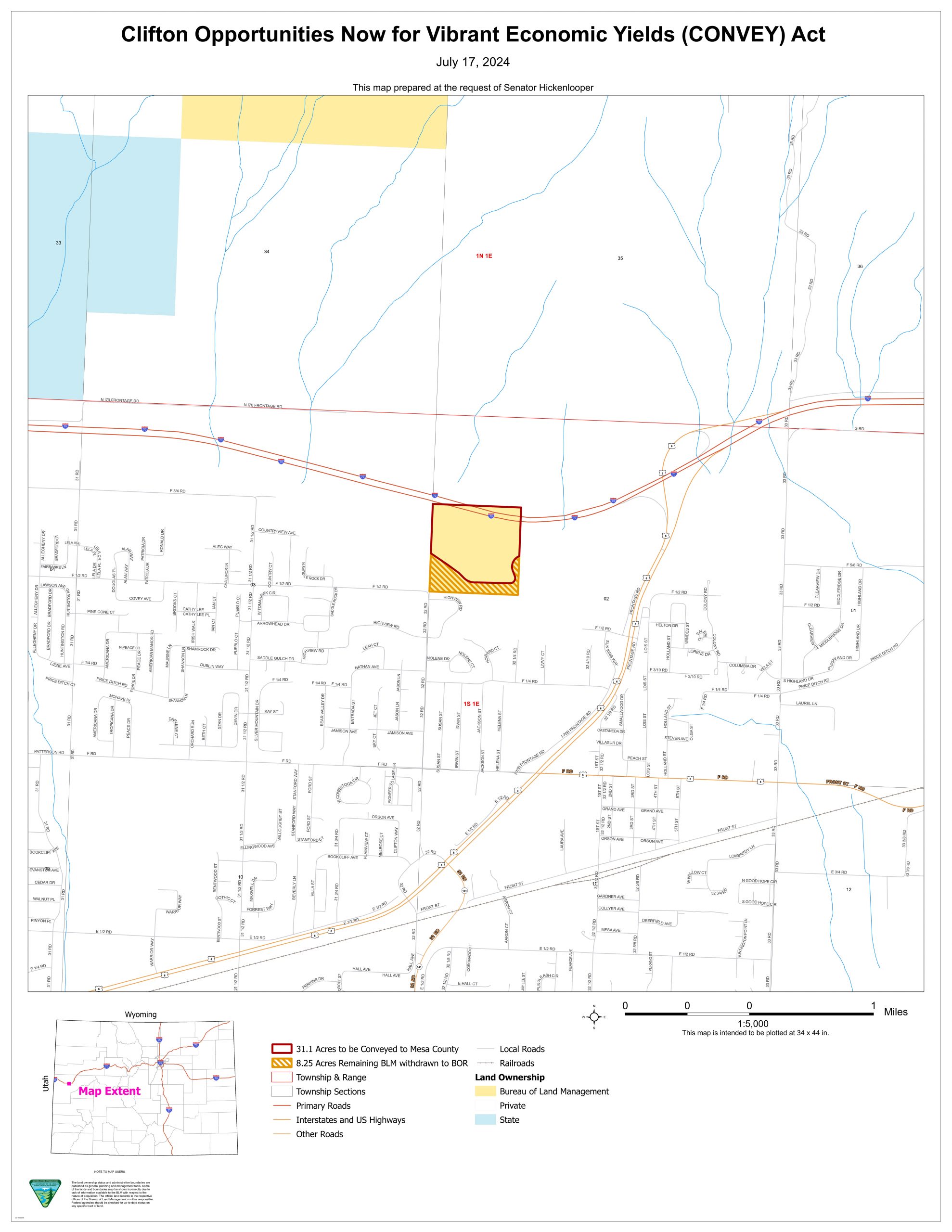
Companion legislation has already passed the House of Representatives.
Bennet, Hickenlooper Welcome $9.7 Million from Bipartisan Infrastructure Law for Colorado Airports
Washington, D.C. – U.S. Senators Michael Bennet and John Hickenlooper celebrated $9.7 million in funding from the Federal Aviation Administration’s (FAA) Airport Improvement Program (AIP) for seven airports in Colorado. These investments are made possible through the Bipartisan Infrastructure Law, which has provided over $400 million to airports across the state.
“I’m grateful DOT is supporting Colorado’s airports as they work to meet our state’s changing needs,” said Bennet. “These dollars will help improve safety and capacity so our airports can better connect our communities and fuel our economy.”
“Colorado’s airports are a lifeline to rural communities,” said Hickenlooper. “Our Bipartisan Infrastructure Law is repairing roads and runways at airports across the state to keep those communities connected.”
This funding includes:
- $6,366,686 for Denver International Airport to repair existing paved taxiway;
- $1,200,000 for the Yampa Valley Airport for a new Aircraft Rescue and Fire Fighting vehicle and equipment to enhance passenger safety;
- $615,834 for the Wray Municipal Airport to construct a new taxiway in line with current safety standards;
- $583,377 for the Telluride Regional Airport to construct apron pavement, where airplanes park and unload passengers;
- $513,559 for the Greeley-Weld County Airport Authority to repair apron pavement;
- $365,574 for the Cortez Municipal Airport to reconstruct a terminal access road; and
- $134,347 for the Monte Vista Municipal Airport to extend paved taxiway in line with current safety standards
Earlier this month, the FAA announced over $10 million for 16 Colorado airports. In February, Bennet and Hickenlooper also welcomed $40.6 million for infrastructure improvements at Denver International Airport, Colorado Springs Airport, and Centennial Airport – made available through the Airport Terminal Program, one of three aviation programs created through the Bipartisan Infrastructure Law.
Bennet, Hickenlooper Celebrate Coloradans Competing in 2024 Summer Olympic Games
Washington, D.C. – Colorado U.S. Senators Michael Bennet, co-chair of the bipartisan Senate Olympic and Paralympic Caucus, and John Hickenlooper, alongside five of their Senate colleagues, introduced a bipartisan resolution in support of the U.S. Olympic and Paralympic teams competing in the 2024 Summer Olympic Games in Paris, France.
“Team USA exemplifies rigorous competition, fair play, and the pursuit of dreams,” wrote Bennet, Hickenlooper, and the senators. “The people of the United States stand united in respect, admiration, and pride for the athletes of Team USA and their athletic accomplishments, sportsmanship, grace under pressure, goodwill toward other competitors, and commitment to excellence.”
Colorado Springs is home to the U.S. Olympic & Paralympic Committee (USOPC) as well as the Colorado Springs Olympic & Paralympic Training Center. Of the more than 590 athletes who will represent the United States in this year’s Olympics, 28 are from Colorado.
“On behalf of Team USA and the U.S. Olympic and Paralympic Committee, we sincerely thank Senators Blackburn, Hickenlooper, Klobuchar, and Lankford for introducing this resolution. The support of the U.S. Senate as our team heads to Paris means the world to our dedicated athletes and coaches. We also appreciate the Senate’s commitment to partnering with us as we prepare for the 2028 Olympic and Paralympic Games in Los Angeles. We wholeheartedly support this resolution and eagerly anticipate its swift passage,” said Sarah Hirshland, CEO, USOPC.
The resolution is supported by the USOPC.
The text of the resolution is available HERE.
REPRESENTATIVE PETTERSEN
Pettersen Joins Fellow Colorado Lawmakers in Calling for Additional Firefighting Crews to Help Battle Fires
LAKEWOOD —Last night, U.S. Representative Brittany Pettersen, U.S. Senators Michael Bennet and John Hickenlooper, and Representative Joe Neguse called on the National Interagency Fire Center (NIFC) to provide additional support for the State of Colorado as it continues to battle several ongoing wildfires, including the Quarry Fire in Jefferson County, that threaten homes and communities across the Front Range. In a letter to Chief Mark Hilton, Rep. Pettersen and Colorado lawmakers urged the NIFC to meet Colorado’s request for additional boots on the ground, requesting hand crews that are available as soon as possible, in addition to any available engines, incident management teams, and aviation support.
Hand crews are made up of highly skilled wildland firefighters that fight at the frontline of fires, creating firelines and defensible spaces, conducting mop-up operations, improving efficiency, and relieving firefighters and medic engines.
“We understand the pressures facing our wildland firefighting workforce, as wildfires rage all across the western United States and continue to threaten many of our communities,” wrote the lawmakers. “Existing resources are stretched thin to meet those demands. We strongly support the State of Colorado’s request for additional resources immediately, and over the coming weeks and months, as we continue to face extreme heat and drought conditions that may exacerbate existing fires and increase the risk of additional wildfires. Time is of the essence to save lives and homes,”
Find the full letter to NFIC Chief Mark Hilton HERE and below.
The NIFC works to foster cooperation and collaboration between national and state wildland fire entities to ensure wildland fire personnel and other emergency services employees across the nation receive the support and information they need to do their job in a safe, effective, and efficient manner.
July 31, 2024
Dear Chief Hilton,
Given the increased wildfire risk we are facing across our State, we write to request your strong support for the State of Colorado as it continues to battle several ongoing wildfires that threaten homes and communities. Specifically, we urge you to work with the State of Colorado to meet requests for available hand crews needed as soon as possible, in addition to any available engines, incident management teams, and aviation support.
The Alexander Mountain Fire in Larimer County, the Stone Canyon and Lake Shore Fires in Boulder County, and the Quarry Fire in Jefferson County have all begun within the last 48 hours. This has prompted the evacuation of thousands, claiming the life of one of our community members, burning more than a combined 9,000 acres, and destroying at least five structures.
The State of Colorado has activated all available resources to address these wildfires, including new aerial resources, and are actively coordinating with the National Interagency Fire Center and neighboring states. With existing wildfires and the continued high wildfire risk, the State expects to need additional resources in the coming days and weeks.
We understand the pressures facing our wildland firefighting workforce, as wildfires rage all across the western United States and continue to threaten many of our communities. Existing resources are stretched thin to meet those demands. We strongly support the State of Colorado’s request for additional resources immediately, and over the coming weeks and months, as we continue to face extreme heat and drought conditions that may exacerbate existing fires and increase the risk of additional wildfires. Time is of the essence to save lives and homes.
We appreciate your attention to this urgent matter.
Pettersen Bill to Prevent the Financing of Illegal Synthetic Drugs Passes Senate, Heads to President’s Desk for Signature
WASHINGTON— The United States Senate last week passed U.S. Representative Brittany Pettersen’s bipartisan legislation to prevent the financing of illegal synthetic drugs. Pettersen introduced the bill alongside Monica De La Cruz (R-TX), and Andy Ogles (R-TN), and it passed the House of Representatives in May of 2023. The bill is now headed for the President’s desk to be signed into law.
The Preventing the Financing of Illegal Synthetic Drugs Act (H.R. 1076) directs the Comptroller General of the United States to study and report on illicit financing associated with synthetic drug trafficking. The study will lay out for Congress the business model of the organizations carrying out the trafficking, how they move and hide their illicit gains, and what the U.S. government can do to thwart fentanyl money laundering.
According to the Centers for Disease Control and Prevention, over 107,000 people in the United States died from drug overdoses or poisonings in 2023, with 75% of those deaths involving synthetic opioids like fentanyl.
“I know from experience what American families are facing because of our worsening opioid crisis. My mother struggled with an opioid addiction for 30 years, and I came to Congress to combat this public health crisis at the source,” said Pettersen. “Deaths involving synthetic opioids, such as illicit fentanyl and methamphetamine, increased by 22 percent in 2021, and continue to rise in the U.S. and globally. If we want to reverse the current trends, an important first step is stopping the organizations that are trafficking these drugs into our communities. This bill will shed light on the finances of these organizations, and I’m proud this important work was signed into law.”
Full text of the bill can be found here.
Inspired by her own mother’s struggle, this bill is just the latest in Pettersen’s ongoing efforts to address the drug epidemic in the United States. These include measures to prevent the import of illicit drugs, and prevent overdose deaths by ensuring airplanes, law enforcement, and hospitals are able to distribute naloxone when necessary.
REPRESENTATIVE LOPEZ
Rep. Greg Lopez Sounds the Alarm: The U.S. National Debt Surpassed $35 Trillion
WASHINGTON D.C. – Congressman Greg Lopez (CO-04) released the following statement regarding the U.S. national debt surpassing $35 trillion.
“The U.S. national debt just surpassed $35 trillion. That’s over $2 trillion added onto the debt in just one year. If the federal government continues to spend money at its current rate, the debt will spiral to $55 trillion in just ten years.” Said Rep. Greg Lopez. “As a new member of the Budget Committee, I hope that this $35 trillion marker is the last alarm necessary to convince Americans to vote with their wallets and to consider who exactly has their best interest in mind when it comes to tackling this deficit and out of control spending.”
Background:
According to the House Budget Committee, the gross national debt is currently $35 trillion. This equates to:
- $104,497 per person
- $266,275 per household
- $483,889 per child
The debt one year ago was $32.65 trillion, meaning that the debt has increased by $2.35 trillion over the past 12 months. This rate of increase equates to:
- $196 billion in new debt per month
- $6.4 billion in new debt per day
- $268 million in new debt per hour
- $4.5 million in new debt per minute
- $74,401 in new debt per second
The U.S. Treasury Department reports the amount of debt outstanding at the end of the previous business day. The report can be found HERE.