
The 2050 RTP outlined in Chapter 4 includes several planned improvements addressing the current and future transit needs of the Colorado Springs region. It builds on previous planning work, responds to public priorities, and supports continued growth with a more robust, usable, and effective transit system.
Implementing the full vision would achieve many of the goals of MMT and its stakeholders:
- Make transit a more competitive travel option, especially along the seven identified enhanced transit corridors
- Tailor new service options to demand by introducing innovative mobility zones that can build up transit demand in unproven or growing markets
- Improve the transit service for existing riders by increasing frequency and extending service span on all local routes
- Increase access to jobs and services by combining some existing routes into new crosstown routes
- Serve areas of high existing and expected growth with new local and express transit routes
- Sustainably support service expansion with capital investments in new buses, transit centers, a new maintenance facility, and establishing programs within MMT to partner with municipalities to improve the accessibility, comfort, and competitiveness of riding transit in the Pikes Peak region
Example: Transit Making a Difference
Oklahoma City is a growing, economically diverse metro of over 600 square miles. Over the past 15 years, Oklahoma City has had multiple planning processes that helped develop a vision for a robust regional transit system. When discussions about improving transit began, the system was almost exclusively for those who had limited mobility choices. It has since grown to include service seven days a week, with improved frequency. Oklahoma City implemented a streetcar downtown circulator as well as its first Bus Rapid Transit route. Both investments are crucial to attracting transit users in a region where transit has not historically been strong. The BRT project, which was implemented in late 2023, has attracted 1,200 new daily riders, most of whom did not use transit before. Two additional corridors are being planned, as well as regional service, and improved local service. Colorado Springs has the opportunity to follow Oklahoma City’s path, where a vision for improved service is incrementally funded and implemented.
Implementing this ambitious vision won’t happen all at once. This chapter outlines a potential phasing approach to implementing the short-, mid- and long-term implementation schedule of those planned improvements. The horizon years for the short-, mid- and long-term implementation schedule are 2030, 2040, and 2050, respectively.
This implementation schedule is primarily based on the project prioritization outcomes discussed in Chapter 4. The team also considered other factors such as availability of financial resources and interrelation of projects (such as implementing a transit center before implementing the routes serving it) and ongoing projects that are proposed for implementation in the short-, mid- and long-term, respectively. Almost all investments in the Implementation Plan beyond the short-term recommendations require additional financial resources to implement. Leveraging local, state, and federal funding sources will be necessary to implement these investments. Costs shown in this section are all represented in 2024 dollars. Assumptions for costs are included in Appendix B.
Short-Term (2024-2030)
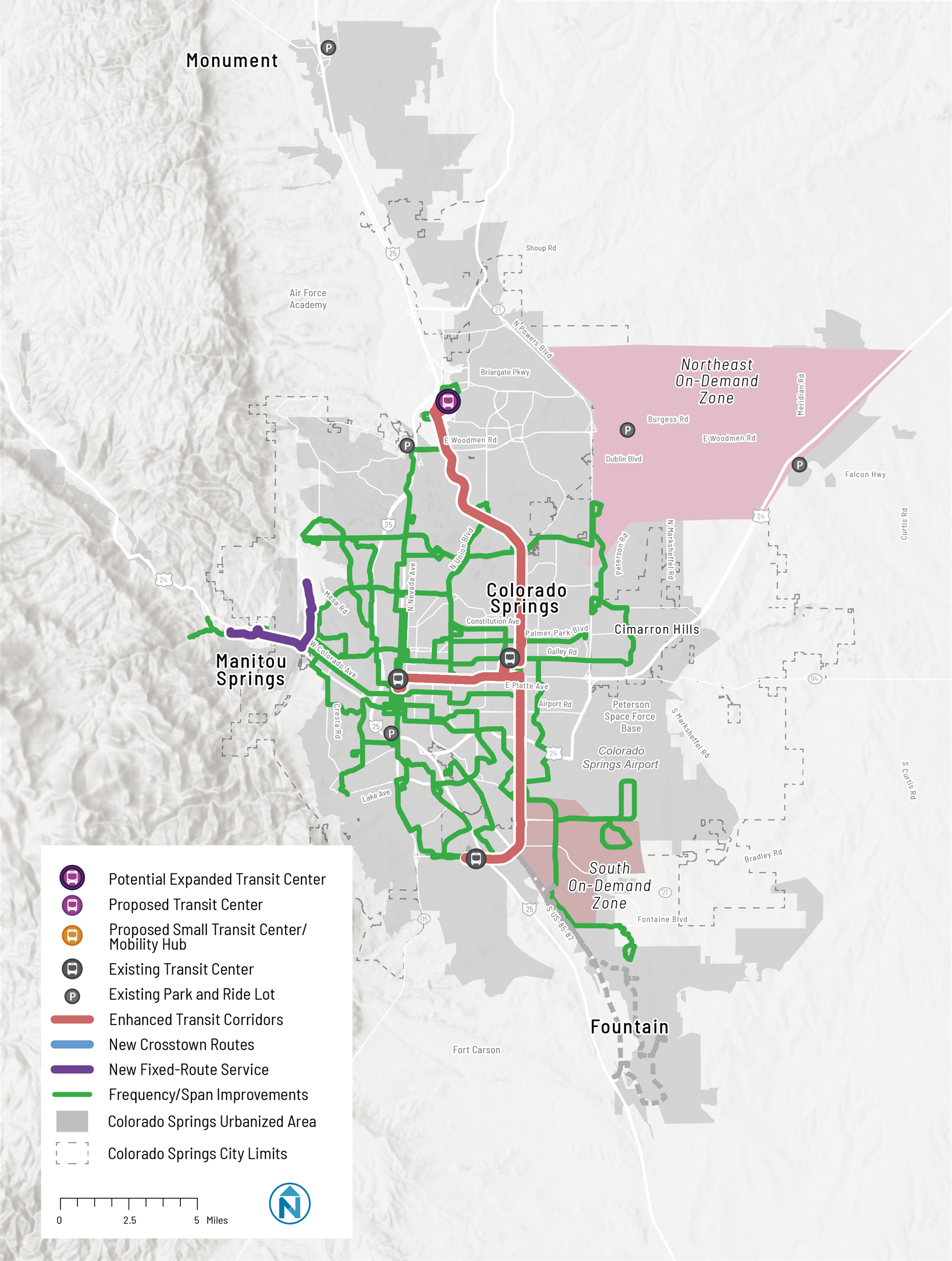
Even without an infusion of new funding beyond the additional support from new statewide transit funding, there are several projects that MMT and its partners can advance to achieve many of the goals of the transit plan over the next 5-6 years. Table 27 outlines the list of projects while Figure 65 shows those projects mapped with the existing system. The following text beginning on page 7-138 describes these projects in more detail.
Table 27. Short-Term (2024-2030) Projects
| Investment Theme | Projects | Capital Cost ($M) | Annual Operating Cost ($M) |
|---|---|---|---|
| Enhanced Transit Corridors | Academy Blvd | $255.0 | $3.8 |
| Enhanced Transit Corridors | Platte Ave | $57.0 | $0.2 |
| New Fixed-Routes | Manitou/Garden of the Gods Shuttle | $4.6 | $0.2 |
| Innovative Mobility Zones | Northeast | $0.4 | $1.5 |
| Innovative Mobility Zones | South | $0.2 | $1.0 |
| Extend Service Span | Span Improvements (Short-Term) | – | $1.0 |
| Improve Capital Infrastructure | Voyager Transit Center (Expansion) | $2.0 | – |
| Improve Capital Infrastructure | Bus Stop Amenities & Accessibility Upgrades (Short-Term) | $5.0 | – |
| Improve Capital Infrastructure | Bus Speed & Reliability Improvements (Short-Term) | $5.0 | – |
| N/A | Additional Complementary ADA Paratransit | – | $0.2 |
| TOTAL | All Projects | $330 | $7.9 |
Increasing Sunday Service – A Case Study
In 2022, Spokane Transit (an agency similar in size and scope to MMT) increased the span of service by 3-4 hours on Sunday evenings on their highest ridership routes. Later evening service responded to calls from the community to be able to return home from job opportunities. On the three improved routes, the agency increased operating hours by 12-28%, and saw a ridership increase of 39-52% as a result. In Spokane, the additional evening service increased ridership throughout the day as well as during the time of increased service.
The early ending time of MMT’s Sunday service suggests that a similar improvement in Colorado Springs will also significantly increase Sunday ridership.
Figure 66. Short-Term Projects (2024-2030)
ETCs
Two ETCs are prime candidates to advance in the short-term given both the need and the level of advanced planning work either completed or underway. MMT has begun the process for defining an Enhanced Transit project along Academy Boulevard, and this is likely to be the first ETC to advance from the long-term vision. As the highest ridership corridor in the MMT network, this project has the potential to set the tone for future ETC implementation and establish a replicable process for advancing projects to implementation (regardless of the eventual funding source).
The City of Colorado Springs has recently completed the Platte Avenue Corridor Study which identified several possible improvements to Route 5 in the Platte Avenue corridor but stops short of recommending a specific transit project scope. This plan can serve as a baseline for MMT and its partners to better define the Platte ETC project during the short-term horizon, even if implementation of the project lags into the mid-term horizon.
Innovative Mobility Zones
Although MMT should conduct a more detailed prioritization effort before launching its first Innovative Mobility Zone, the project team considers two zones to be promising candidates for an initial launch. The Northeast Mobility Zone would capture a large swath of Colorado Springs that has recently experienced – and continues to experience – rapid growth but lacks access to fixed-route transit. This zone would provide important data to MMT about the depth of the transit market in this part of the community before implementing new fixed-routes in the future. The South Mobility Zone would serve an area experiencing rapid growth in industrial jobs and provide another test case for exploring how to serve jobs that are harder to serve with traditional fixed-route transit.
Improved Span/Frequency
One of the most promising short-term projects is the expansion of the span of service on existing routes, particularly on Sunday evening. MMT could extend service with minimal impact on revenue vehicle requirements or number of operators.
Improved Capital Infrastructure
Finally, the project team recommends advancing upgrades to the existing Voyager Transit Center in the short term. These upgrades could be included in the Academy Blvd ETC project pending the outcome of that study and would better support implementation of the I-25/Voyager Express service. In addition to this facility project, the short-term implementation period includes a recommendation to launch both a bus stop accessibility/amenity program as well as a bus speed and reliability program. While the initial investments in this period may be limited, establishing a process by which MMT and its partners can systematically improve the passenger experience will provide an important foundation to build on at-scale in future phases of the plan.
Medium-Term (2031-2040)
The 2030-2040 horizon year includes the majority of the projects identified in the 2050 RTP given expected growth and existing gaps. Implementing projects in this phase and the long-term phase would likely require additional funding sources to be identified as these represent substantial costs in terms of both ongoing operating dollars and one-time capital investments. Table 28 and Figure 66 display the list of medium-term projects and map the projects (along with the short-term recommendations), respectively.
Table 28. Medium-Term (2031-2040) Projects
| Investment Theme | Projects | Capital Cost ($M) | Annual Operating Cost ($M) |
|---|---|---|---|
| Enhanced Transit Corridors | North Nevada | $150.0 | $1.7 |
| Enhanced Transit Corridors | South Nevada | $123.0 | $1.7 |
| Enhanced Transit Corridors | Colorado Ave | $89.0 | $1.4 |
| New Crosstown Routes | Union Blvd | $11.5 | $2.4 |
| New Crosstown Routes | Lake | $9.5 | $1.8 |
| New Fixed-Routes | Citadel to Astrozon | $5.4 | $1.9 |
| New Fixed-Routes | Woodmen | $8.7 | $2.7 |
| New Fixed-Routes | Banning Lewis Ranch (North) | $6.9 | $2.3 |
| New Fixed-Routes | I-25/Voyager Express Service | $6.0 | $3.0 |
| New Fixed-Routes | U.S. 24/Falcon Express Service | $7.2 | $3.8 |
| Innovative Mobility Zones | Central | $0.5 | $1.8 |
| Innovative Mobility Zones | Southeast | $0.4 | $1.4 |
| Innovative Mobility Zones | Northgate/Gleneagle | $0.2 | $1.0 |
| Improve Existing Route Frequency | Route Frequency Improvements (Short-Term) | $8.4 | $2.6 |
| Extend Service Span | Span Improvements (Medium-Term) | – | $2.7 |
| Improve Capital Infrastructure | Woodmen/Powers Transit Center (New) | $7.5 | – |
| Improve Capital Infrastructure | Carefree Transit Center (New) | $7.5 | – |
| Improve Capital Infrastructure | Bus Stop Amenities & Accessibility Upgrades (Medium-Term) | $10.0 | – |
| Improve Capital Infrastructure | Bus Speed & Reliability Improvements (Medium-Term) | $10.0 | – |
| Improve Capital Infrastructure | New Maintenance Facility | $45.0 | – |
| N/A | Additional Complementary ADA Paratransit | – | $3.1 |
| TOTAL | All Projects | $507 | $40.0* |
*Including ongoing short-term operating costs
Figure 67. Short- and Medium-Term Projects (2024-2040)

ETCs
The project team recommends advancing three additional ETC projects after the Academy Blvd and Platte Ave corridors: North and South Nevada, and Colorado Avenue. Although the City of Colorado Springs has already studied the North Nevada corridor, the recommendations from that effort should be revisited closer to implementation to update corridor conditions and engage stakeholders in a planning process that results in a viable project. Pairing the North Nevada corridor with the South Nevada corridor could unlock additional opportunities for outside grant funding by generating higher ridership and serving parts of the community that are more transit-dependent. The Colorado Avenue corridor is already served by one of MMT’s busiest routes – Route 3 – and would complete the east-west ETC spine (along with the Platte ETC) through central Colorado Springs.
Crosstown Routes
This phase includes the introduction of two new crosstown routes. The Lake Corridor, which largely replaces the existing Route 4, provides new connections between important job centers near the Broadmoor and south/southeast Colorado Springs. The Union Blvd Crosstown Corridor combines existing routes 18 and 38 and introduces regular fixed-route service to a part of the region that is currently only served by deviated fixed-route service. This new north-south crosstown route would be anchored by the UC Health Memorial medical center in the north and the Astrozon/Hancock/Academy area to the south.
New Routes
The medium-term implementation phase includes the majority of new fixed-route service recommended in the 2050 RTP, although it is important to note that implementing such a large expansion in MMT’s services would require identification of additional, reliable funding sources beyond the existing system’s expected revenue. Most of the new routes in this phase would serve high-growth communities in North and Northeast Colorado Springs, including two new Express routes connecting Downtown Colorado Springs to the community of Falcon along US-24 and connecting Downtown Colorado Springs with Voyager Transit Center along I-25.
Innovative Mobility Zones
This phase recommends exploring implementation of innovative mobility zones in areas that are expected to continue to experience rapid growth but that may not be ready for regular fixed-route service, namely the Southeast Zone and the Northgate/Gleneagle Zone. While additional improvements to fixed-route service frequency and span are being phased in, this phase could also see implementation of an innovative mobility zone in Central Colorado Springs to further enhance transit service availability. Depending on the performance of the Northeast Zone, implementation of new fixed-route service could justify shrinking the boundary of the zone to better align with gaps in fixed-route transit coverage – or elimination of the zone altogether.
Improved Span/Frequency
MMT should continue to expand service span as vehicle and operator availability allow during the medium term. If a new, reliable funding source is identified, this phase would also include an initial expansion in service frequency along routes beyond those identified as ETCs or Crosstown routes.
Improved Capital Infrastructure
Due to the large expansion of fixed-route service in this phase, the project team has identified several capital projects that would be needed to support the new service. New capital projects include:
- A new transit center at Woodmen/Powers (near St. Francis Hospital) to serve new local routes along Tutt Blvd and Woodmen Rd.
- A new transit center at Carefree Circle North to connect existing services to new local service along Tutt Blvd.
- Expansion of the Bus Stop Accessibility/Amenity and Bus Speed & Reliability programs launched during the short-term period
- A new Maintenance Facility to support the expanded bus fleet needed to serve routes launched during this phase and in accordance with expected ZEV needs as identified in the ZEV Plan
Long-Term (2041-2050)
The long-term phase includes the remaining projects needed to fully implement the 2050 RTP. These projects largely serve areas where major growth is not expected to occur until much later in the planning horizon or not expected to occur at all but where existing transit gaps may remain. Table 29 and Figure 67 display the list of long-term projects and map the complete RTP at full implementation in 2050, respectively.
Table 29. Long-Term (2041-2050) Projects
| Investment Theme | Projects | Capital Cost ($M) | Annual Operating Cost ($M) |
|---|---|---|---|
| Enhanced Transit Corridors | Airport | $180.0 | $4.0 |
| Enhanced Transit Corridors | Tutt Blvd | $147.0 | $3.3 |
| New Crosstown Routes | Garden of the Gods/Austin Bluffs | $8.1 | $0.9 |
| New Fixed-Routes | Tutt North/Briargate | $8.9 | $2.9 |
| New Fixed-Routes | Banning Lewis Ranch (South) | $12.6 | $4.6 |
| New Fixed-Routes | Voyager to Monument | $12.5 | $5.2 |
| Innovative Mobility Zones | Northwest | $0.2 | $1.0 |
| Improve Existing Route Frequency | Route Frequency Improvements (Medium-Term) | $9.6 | $2.7 |
| Improve Existing Service Span | Route Span Improvements (Long-Term) | – | $3.1 |
| Improve Capital Infrastructure | Briargate Transit Center (New) | $7.5 | – |
| Improve Capital Infrastructure | Innovation Parkway Mobility Hub (New) | $3.8 | – |
| Improve Capital Infrastructure | Astrozon Mobility Hub (New) | $3.8 | – |
| Improve Capital Infrastructure | Bus Stop Amenities & Accessibility Upgrades (Long-Term) | $10 | – |
| Improve Capital Infrastructure | Bus Speed & Reliability Improvements (Long-Term) | $10 | – |
| N/A | Additional Complementary ADA Paratransit | – | $1.1 |
| TOTAL | All Projects | $413 | $67.7* |
*Including ongoing short- and medium-term operating costs
Figure 68. Short-, Medium-, and Long-Term Projects (2024-2050)

ETCs
The project team recommends implementing the remaining two ETC projects during this phase. The Airport ETC project would connect Downtown Colorado Springs with the Colorado Springs Airport. Improvements to existing Route 37 frequency and span and implementation of the South innovative mobility zone will likely address improved transit service in this part of the community until the ETC project is implemented. The Tutt Blvd ETC represents an upgrade of some existing routes and part of the new Briargate/Tutt local route identified in this implementation phase, and so implementation itself could be phased to introduce the new local service before upgrading part of the route to a new ETC. This corridor is experiencing rapid growth today but could benefit from additional time to build ridership and make other connectivity and land use improvements that would support a competitive ETC project.
Crosstown Corridors
The final crosstown project is the Garden of the Gods/Austin Bluffs Pkwy corridor. This project would largely replace two existing local routes that would receive frequency/span improvements in the short- and medium-term phases of the plan and depending on a detailed analysis of impacts to vehicle and operator needs could be accelerated through the first phase of systemwide frequency upgrades.
New Routes
The project team recommends implementing the Banning Lewis Ranch South new route during the long-term given the expected longer buildout horizon of Banning Lewis Ranch toward US-24 and further south (the Southeast Zone would serve this area in the interim). Also given long term growth trends, the team recommends introducing local service between Monument and Voyager Transit Center during the long-term planning horizon. The team also recommends implementing a Garden of the Gods to Manitou Springs circulator in the long-term after a more thorough study of the benefits and infrastructure that would be needed to operate such a service. Given the focus on serving tourists visiting Manitou Springs and Garden of the Gods Park, this project may also be eligible to advance on a different timeline with unique funding sources that may not be available for other routes in the proposal.
Innovative Mobility Zones
The final Innovative Mobility Zone – the Northwest Zone – would be implemented in the long-term horizon. Depending on performance of the other zones in conjunction with implementation of new fixed-route service, the remaining zones may be phased out during the long-term horizon or have their boundaries adjusted to tailor resources to areas with the highest need.
Improved Span/Frequency
With implementation of the full RTP, all routes would be upgraded to at least 30-minute weekday frequency and would operate earlier in the morning and later in the evening than routes that are currently scheduled on both weekdays and weekends.
Improved Capital Infrastructure
- While less pronounced than the medium-term phase, additional capital projects are likely needed to support the remaining projects identified in the long-term horizon. Those include:
- A new transit center near Briargate and Powers Blvd to better support network functionality in north/northeast Colorado Springs.
- A new Mobility Hub at Astrozon (near Academy Blvd & Hancock Expwy) to connect existing services.
- A new Mobility Hub at Innovation Parkway to connect the new Airport ETC to the new Banning Lewis Ranch South route.
- Continuation of the Bus Stop Accessibility/Amenity and Bus Speed & Reliability programs, with the goal to have 100% of bus stops be ADA compliant and to address remaining delay points on local routes that do not receive investment as part of an ETC project.