
Project Background
The 2050 Regional Transit Plan (RTP) serves as a framework for operations, improvements, and ongoing development of fixed route transit services in the Pikes Peak region. The RTP is an appendix to Pikes Peak Area Council of Governments’ (PPACG’s) 2050 Long Range Transportation Plan (LRTP) and is integrated with future roadway, pedestrian, bicycle, specialized, and new mobility plans to form a complete vision for multimodal transportation in the region. Completing and regularly updating the LRTP maintains the region’s compliance with federal and state laws, as well as maintains the region’s eligibility for federal transportation funding. The 2050 LRTP ultimately forms the strategy for the appropriate use of funds to meet the community’s mobility goals.
The RTP was developed through a partnership between Mountain Metropolitan Transit (MMT) and PPACG. Because of their inherent connections, the RTP was completed in conjunction with the 2050 Specialized Transportation Plan or Coordinated Human Services Transportation Plan (CHSTP) as well as MMT’s first Zero Emission Vehicle Transition Plan (ZEV Plan). The focus of the CHSTP is to optimize coordination for specialized transportation (i.e., services for seniors, persons with disabilities, etc.). The ZEV Plan charts a path forward for MMT to transition its vehicle fleet from mostly relying on gasoline- and diesel-powered vehicles to alternative fuel vehicles and is a requirement to be eligible to receive Federal Transit Administration (FTA) grants that fund low- and no-emission vehicles. The RTP was developed with the CHSTP and ZEV Plan to capitalize on opportunities to best support users of all services. The teams jointly developed the goals/objectives, engaged the Advisory Committee, and conducted engagement activities for maximum integration.
The 2050 RTP builds off previous planning efforts, such as the 2045 RTP and ConnectCOS to develop a vision for the future of transit in Colorado Springs and adjacent communities. Since the 2045 RTP was adopted in early 2020, transit in the region has been acutely affected by the COVID-19 pandemic. Like most transit agencies across the country, MMT saw a significant decline in the number of daily boardings beginning in March 2020 and scaled back services across the system. Thanks in part to federal COVID-19 relief funds as well as a quick recovery in tax revenue, MMT has been steadily restoring service and seeing ridership bounce back in response, reaching 89% of 2019 annual ridership in 2023. Ongoing industrywide challenges with hiring and retaining bus operators as well as adapting to new travel patterns with the increased adoption of remote work have continued to present barriers to implementing many of the recommendations from the 2045 RTP.
Given this new paradigm for transportation needs in the region, the 2050 RTP represents a unique opportunity to take a fresh approach to charting a vision for transit in the Pikes Peak region over the next 25 years.
Study Area
The RTP addresses transit needs at two overlapping scales within the region. At its largest extent, the study area comprises the urbanized area (UZA) and the Pikes Peak region, for which PPACG is the federally designated metropolitan planning organization (MPO). The MPO boundary, shown in Figure 1, includes the cities of Colorado Springs, Fountain, Monument, and Manitou Springs, as well as portions of El Paso and Teller counties. PPACG also serves a larger geography for planning purposes, which encompasses 16 local governments, representing a total population of 772,504 residents across 4,878 square miles.
Figure 1: Study Area
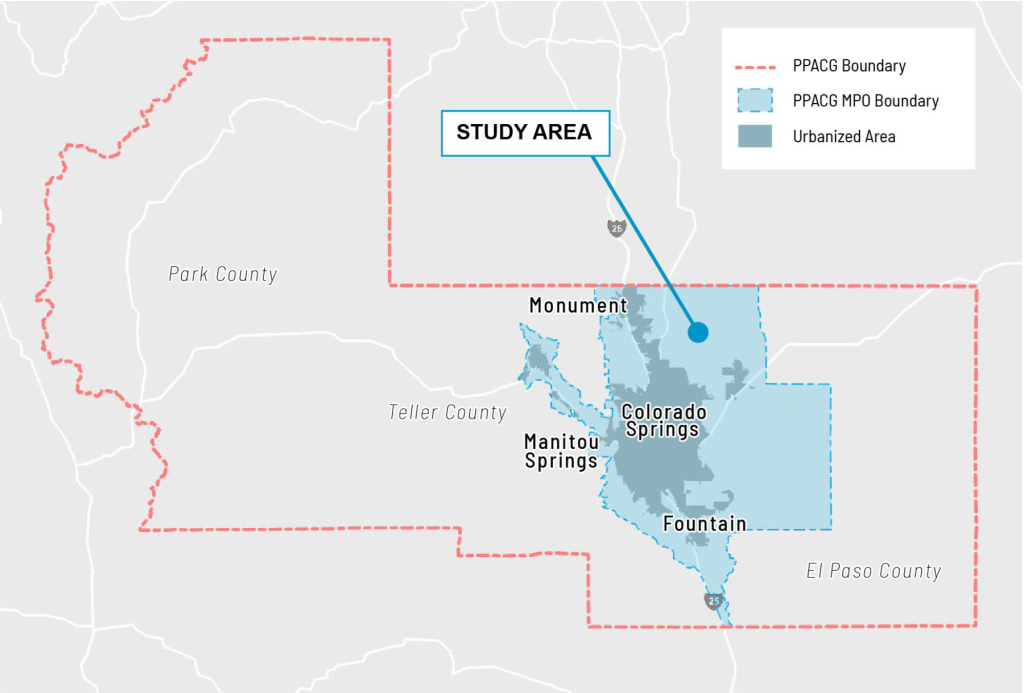
The second layer of the study area focuses on MMT’s current service area which is smaller than the MPO boundaries and primarily within the UZA in and around the City of Colorado Springs and the City of Manitou Springs, with a land area of roughly 200 square miles.
Planning Process
MMT, in partnership with PPACG and consultant team staff, worked cooperatively to develop and implement a process to create the plan while engaging stakeholders and the public throughout the process. MMT convened a Project Management Team (PMT) to help guide development of the project, which was responsible for day-to-day project activities, schedule, and budget management. The members of the PMT are shown in Table 1.
Table 1. Project Management Team Membership
| Organization | Project Management Team Members |
|---|---|
| Mountain Metropolitan Transit | Jacob Matsen, Transit Planning Supervisor (Regional Transit Plan Project Manager) |
| Mountain Metropolitan Transit | Lan Rao, Transit Division Manager |
| Mountain Metropolitan Transit | Kevin Teagarden, Senior Transit Planner |
| Pikes Peak Area Council of Governments | Laura Crews, Mobility Coordinator (Specialized Transportation Plan Project Manager) |
| Pikes Peak Area Council of Governments | John Liosatos, Transportation Planning Manager |
| Consultant Team | Thomas Wittmann, Nelson\Nygaard (Project Manager) |
| Consultant Team | Jonathan Mosteiro, Nelson\Nygaard (Deputy Project Manager) |
| Consultant Team | Ezra Pincus-Roth, Nelson\Nygaard (Specialized Transportation Plan Project Manager) |
| Consultant Team | Angela Woolcott, Kearns & West (Public Engagement Lead) |
| Consultant Team | Shawn Strate, Olsson (Zero Emission Vehicle Transition Plan Project Manager) |
The PMT extended invitations to a range of organizations involved in planning and delivering transportation services in the region to serve on the project’s Advisory Committee. This committee was designed to include stakeholder organizations with interest in the transit planning process and to provide critical input and guidance to the team. Advisory Committee members represented multiple constituencies such as seniors, veterans, county-level interests, city-level interests, advocacy groups, military installations, persons with disabilities, etc.
Advisory Committee participants committed to engagement throughout the RTP’s development and to act as a liaison with the constituents they represent. The Advisory Committee met as a team at two major project milestones to review the latest plan developments. Members were given time to review the information and convey what they had learned to their constituents. Advisory Committee members provided input to the project team (from their perspective). This information helped guide the plan’s focus. The activities of the Advisory Committee are discussed further in Chapter 2.
The PMT and Advisory Committee steered the plan through several steps in the planning process as outlined in Figure 2. The steps in this process are explained in more detail in the following chapters of this report:
- The PMT conducted a Project Kickoff Meeting in September 2023 that outlined the purpose of the planning process, confirmed major milestones and data availability, and generated ideas for key outcomes that MMT and PPACG staff desired from the 2050 RTP.
- Based on available data, the consultant team conducted a deep dive into existing and future conditions for transit in the region including ridership trends, financial performance, and expected growth. This analysis is summarized in Chapter 3 of this report.
- The PMT presented the findings of the Existing Conditions analysis to the Advisory Committee as well as gathered input on goals and objectives for strategies to address these conditions at a meeting in February 2024.
- The PMT used the findings of the Existing Conditions Analysis as well as Advisory Committee feedback to generate draft transit improvement concepts between January and March of 2024, including a concept development workshop in March to refine the initial transit investment strategies with additional MMT and PPACG stakeholders.
- The PMT then developed the 2050 RTP that represents an unconstrained vision for where transit improvements are most needed to address existing gaps and expected growth (detailed in Chapter 4 of this report).
- The PMT presented the RTP to the Advisory Committee in early April 2024 to verify that the recommendations addressed the needs expressed in the first Advisory Committee meeting, as well as to gauge committee members’ direction on how to prioritize the investments.
- MMT and PPACG conducted a joint Public Open House and corresponding Virtual Open House in late April/early May 2024 to gather feedback from the community on the 2050 RTP as well as priorities for implementation.
- A complete account of stakeholder and community engagement efforts is included in Chapter 2 and Appendix A of this report.
- The consultant team took the community feedback and conducted a project prioritization process as well as a financial analysis of expected costs and revenues available to implement the RTP, as outlined in the Financial Plan (Chapter 5).
- The consultant team also conducted a scan of transit trends and technology to inform strategies for implementing the RTP (Chapter 6).
- The final phased implementation recommendations for the 2050 RTP are outlined in Chapter 7 of this report.
Figure 2: 2050 Regional Transit Plan Development Process

Guiding Principles of the Plan
Identification of goals is a fundamental step in preparation of any transit plan. It is critical to establish the framework within which the agency would pursue its vision. The PMT, with feedback from the Advisory Committee, crafted a set of goals to guide the preparation of the 2050 RTP. These goals align with the vision of MMT and recent planning efforts such as ConnectCOS and are envisioned to facilitate the performance evaluation of the transit system, improve accountability in implementation of the transit plan, and enhance decision making.
The four identified goals are:
- Choice
- Accessibility
- Equity
- Technology
Each goal is supplemented by a set of metrics to be used by MMT for evaluation and improvement of the existing public transportation services as well as the proposed changes per the plan. Table 2 presents the identified goals and performance metrics associated with each goal.
Table 2: Goals and Performance Metrics
| Goals | Description | Performance Metrics |
|---|---|---|
| Choice | Make transit a competitive travel mode. | Number of people within ¼ mile of routes with 15-minute weekday frequencies, or better. Number of jobs within ¼ mile of routes with 15-minute weekday frequencies, or better. |
| Accessibility | Provide access to jobs, schools, medical facilities, social events, and community activities. | Number of people within ¼ mile of MMT network. Number of jobs within ¼ mile of MMT network. Percentage of the UZA population within ¼ mile of MMT network. Percentage of existing public health facilities (with employee count greater than or equal to 20) within ¼ mile of MMT network. Percentage of existing educational facilities (with employee count greater than or equal to 10) within ¼ mile of MMT network. |
| Equity | Maintain or improve service to the people who need it the most. | Number of people in equity focus areas within ¼ mile of MMT network. Number of low-income jobs within ¼ mile of MMT network. |
| Technology | Deploy technology to both improve agency operations and the customer experience. | N/A |