
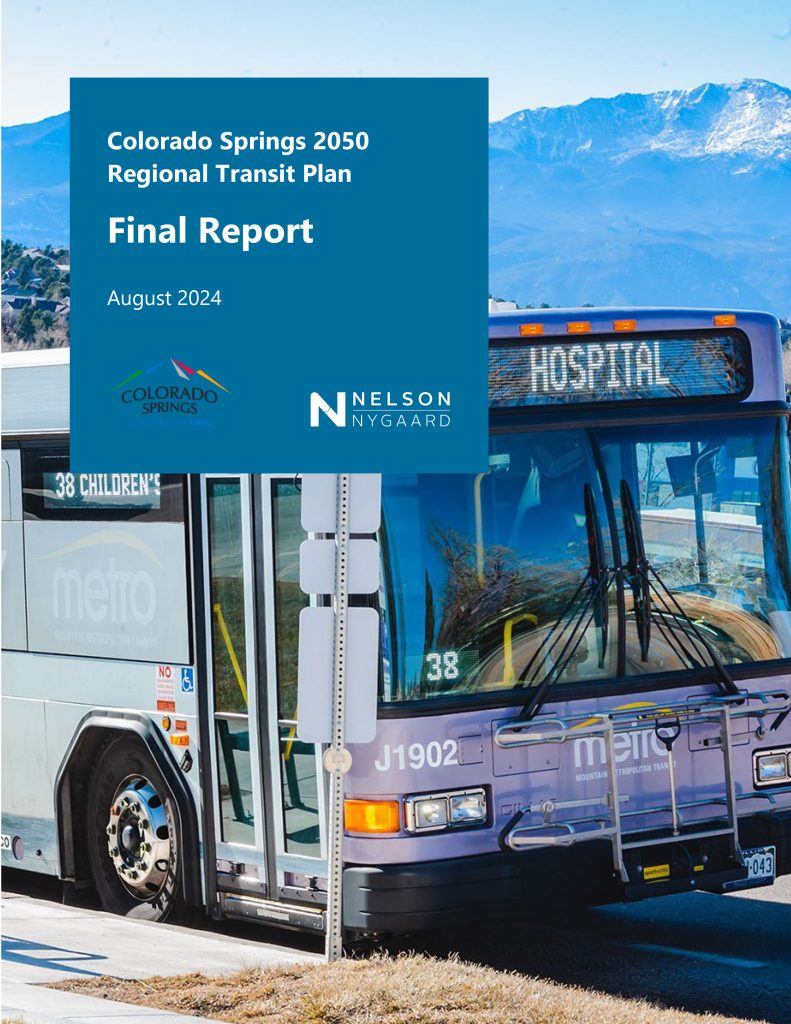
The 2050 Regional Transit Plan (RTP) serves as a framework for operations, improvements, and ongoing development of fixed route transit services in the Pikes Peak region. The RTP is an appendix to Pikes Peak Area Council of Governments’ (PPACG’s) 2050 Long Range Transportation Plan (LRTP) and is integrated with future roadway, pedestrian, bicycle, specialized, and new mobility plans to form a complete vision for multimodal transportation in the region. Completing and regularly updating the LRTP maintains the region’s compliance with federal and state laws, as well as maintains the region’s eligibility for federal transportation funding. The 2050 LRTP ultimately forms the strategy for the appropriate use of funds to meet the community’s mobility goals.
The RTP was developed through a partnership between Mountain Metropolitan Transit (MMT) and PPACG. Because of their inherent connections, the RTP was completed in conjunction with the 2050 Specialized Transportation Plan or Coordinated Human Services Transportation Plan (CHSTP) as well as MMT’s first Zero Emission Vehicle Transition Plan (ZEV Plan). The focus of the CHSTP is to optimize coordination for specialized transportation (i.e., services for seniors, persons with disabilities, etc.). The ZEV Plan charts a path forward for MMT to transition its vehicle fleet from mostly relying on gasoline- and diesel-powered vehicles to alternative fuel vehicles and is a requirement to be eligible to receive Federal Transit Administration (FTA) grants that fund low- and no-emission vehicles. The RTP was developed with the CHSTP and ZEV Plan to capitalize on opportunities to best support users of all services. The teams jointly developed the goals/objectives, engaged the Advisory Committee, and conducted engagement activities for maximum integration.
The 2050 RTP builds off previous planning efforts, such as the 2045 RTP and ConnectCOS to develop a vision for the future of transit in Colorado Springs and adjacent communities. Since the 2045 RTP was adopted in early 2020, transit in the region has been acutely affected by the COVID-19 pandemic. Like most transit agencies across the country, MMT saw a significant decline in the number of daily boardings beginning in March 2020 and scaled back services across the system. Thanks in part to federal COVID-19 relief funds as well as a quick recovery in tax revenue, MMT has been steadily restoring service and seeing ridership bounce back in response, reaching 89% of 2019 annual ridership in 2023. Ongoing industrywide challenges with hiring and retaining bus operators as well as adapting to new travel patterns with the increased adoption of remote work have continued to present barriers to implementing many of the recommendations from the 2045 RTP.
Given this new paradigm for transportation needs in the region, the 2050 RTP represents a unique opportunity to take a fresh approach to charting a vision for transit in the Pikes Peak region over the next 25 years.