
Public and Stakeholder Engagement
Public and stakeholder engagement throughout the planning process was targeted to engage community members who live within the MMT operating area and larger Metropolitan Planning area of the Pikes Peak region. The key audiences included current transit riders, specialized and human services transportation providers, and community based and social services organizations. In addition to key audiences, the project team also engaged the broader public, jurisdictions, businesses, military installations, and community organizations within the planning area. Public involvement and engagement were built upon previous MMT planning efforts as well as leveraging relationships from recent transportation planning efforts. Multiple strategies (Figure 3) were employed to share information about the project, and receive feedback from key audiences, stakeholders, and the public. Table 3 presents the specifics and outcomes of each public involvement strategy adopted by the project team.
Figure 3. Public Involvement Strategies

| Involvement Strategy | Specifics | Outcome |
|---|---|---|
| Stakeholder Interviews | Six stakeholder interviews were conducted. Participating organizations include City of Colorado Springs City Council, City of Colorado Springs Economic Development, City of Fountain, Innovations in Aging, Pikes Peak Housing Network Front Range Passenger Rail District Board Member, and Pikes Peak Rural Transit Authority Community Advisory Committee. | The feedback shared during these interviews informed the technical process including the existing conditions and gap analysis. |
| Focus Groups | Four focus groups were conducted: on-demand focus group, education focus group, health and human services focus group, and business, development and residential focus group. | Feedback themes collected during each focus group informed the technical analysis including existing conditions and identifying gaps in the current system. |
| Stakeholder Advisory Committee | Stakeholder advisory committees for both the 2050 RTP and 2050 CHSTP were engaged. | Developed a common understanding of project goals and objectives, roles and expectations of the stakeholder advisory committee members, findings from stakeholder engagement, existing conditions, project schedule and major technical milestones. |
| Public Meeting | One in-person open house was hosted by the project team which featured a series of informational stations to encourage active public participation. In addition to the in-person open house, two additional events – a virtual “office hours” meeting, and an in-person meeting at the Independence Center – were held that encouraged the community to view, interact, and provide feedback on the materials in-person and digitally. | Approximately, 114 community members provided feedback or attended a virtual or in-person event. The open house had 45 in-person attendees over a two-hour period, and 66 unique digital comment card responses were collected. |
| Digital Engagement | The project team maintained an updated website to educate stakeholders and the community and promote upcoming engagement opportunities. | Throughout the study, the website had 3,177 visits from 2,532 unique users. Peaks in website views corresponded with the plan’s public open house. |
Public involvement throughout the planning process primarily engaged community members who live within the MMT operating area and larger Metropolitan Planning area of the Pikes Peak region. Engagement spanned both the 2050 RTP and CHSTP, while also targeting specific audiences of stakeholders, including current transit riders, human services transportation providers, and community and social services organizations.
Current Transit Riders
Existing ridership helped inform current uses of transit and the specialized system, and how riders’ experiences can be improved. The information gathered from conversations and engagements with this population helped to inform recommendations that would address current and future community mobility needs.
Specialized and Human Services Transportation Providers
Specialized and human services transportation providers are an important audience due to their role in providing local transportation options. Providers were engaged as an operational group to understand their experiences and challenges with providing services to the necessary transit-dependent populations. In addition, a feedback loop was created to provide feedback and conversations between riders and providers.
Community Based and Social Services Organizations
Community based and social services organizations were engaged to provide their feedback and to partner with MMT. Community leaders helped to share information with their constituents and promote upcoming engagement and feedback opportunities.
In addition to key audiences, the project team engaged the broader public, jurisdictions, businesses, military installations, and community organizations within the planning area.
Public Information Approach
Public involvement and engagement were built upon previous MMT planning efforts as well as leveraging relationships from recent transportation planning efforts.
Multiple strategies were employed to share information about the project, and receive feedback from key audiences, stakeholders, and the public.
Stakeholder Interviews
To begin the public involvement process, stakeholders were interviewed in December 2023 and January 2024 to understand their familiarity with the current transit system and what they believe is going well or needs improvement. The feedback shared during these interviews
| Name | Organization |
|---|---|
| Yolanda Avila | City of Colorado Springs City Council |
| Jessie Kimber | City of Colorado Springs Economic Development |
| Sharon Thompson | City of Fountain Mayor |
| Erin Maruzzella | Innovations in Aging |
| Jill Gaebler | Pikes Peak Housing Network Front Range Passenger Rail District Board Member |
| Jim Godfrey | Pikes Peak Rural Transit Authority Community Advisory Committee |
Additionally, a memo summarizing the stakeholder interviews is included in Appendix A.
Focus Groups
To engage various community leaders and organizations in the planning area, the project team hosted the following four focus groups:
- January 17, 2024 – On-Demand Travel Focus Group
- February 7, 2024 – Education Focus Group
- February 7, 2024 – Health and Human Services Focus Group
- February 7, 2024 – Business, Development, and Residential Focus Group
The On-Demand Travel Focus Group was an in-person event hosted at The Independence Center. The three focus groups on February 7, 2024, were virtual meetings. Table 5 summarizes the focus group participants, their organization, and which focus group they attended.
The goal of each focus group was to create a common understanding of the plans, to learn more about how the community utilizes transit, and to identify potential successes or improvements to inform plan recommendations and strategies. Feedback themes collected during each focus group informed the technical analysis including existing conditions and identifying gaps in the current system.
Additionally, a memo summarizing the stakeholder focus groups is included as Appendix A.
| Name | Organization | Focus Group |
|---|---|---|
| Cathy Buckley | Colorado College | Education |
| Catherine Duarte | Colorado Springs Housing and Urban Development | Business, Development, and Residential |
| CJ McCampbell | District 11 | Education |
| Isabel Robben | District 11 | On-Demand Travel |
| Marla Luckey | El Paso County Public Health | Health and Human Services |
| Marsha Unruh | Homefront Military Network | Business, Development, and Residential |
| Buddy Castor | N/A | Paratransit and Specialized Transportation Rider |
| Jeannette Fortin | N/A | Paratransit and Specialized Transportation Rider |
| Loretta Houseman | N/A | Paratransit and Specialized Transportation Rider |
| Mary Kim McCarthy | N/A | Paratransit and Specialized Transportation Rider |
| Toby Cotter | N/A | Paratransit and Specialized Transportation Rider |
| Skyler Rorabaugh | Pikes Peak | Business, Development, and Residential |
| Kevin Coleman | Pikes Peak School District | Education |
| Aaron Simeraro | Silver Key | Health and Human Services |
| Edgar Morales | The Independence Center | Paratransit and Specialized Transportation Rider |
| Mary Rose Evans | The Independence Center | Paratransit and Specialized Transportation Rider |
| Paul Spotts | The Independence Center | Paratransit and Specialized Transportation Rider |
| Scott Land | The Independence Center | Paratransit and Specialized Transportation Rider |
| Jim Spice | University of Colorado – Colorado Springs | Education |
Stakeholder Advisory Committee
Each plan had a dedicated Stakeholder Advisory Committee, which included a diverse representation of the broader community. The project team engaged the Stakeholder Advisory Committees at key milestones throughout the project.
2050 RTP Stakeholder Advisory Committee
The 2050 RTP Stakeholder Advisory Committee met twice throughout the development of the plan. Stakeholders were identified and invited to the committee based on the plan’s boundaries and with the goal of representing a cross-section of jurisdictions, community organizations, state and county representatives, military installations, businesses, and educational institutions. Table 6 provides a list of committee members and their affiliated organizations. Additional stakeholders were invited to participate on the committee; however, the roster reflects active participants only.
The first committee meeting took place on Wednesday, February 21, 2024. The goal of the meeting was to create a common understanding of:
- Project goals and objectives
- Planning landscape and intersections
- Roles and expectations of the Stakeholder Advisory Committee members
- Stakeholder engagement conducted to date and what we’ve heard
- Existing conditions
- Project Schedule and major technical milestones
The second committee meeting took place on Thursday, April 9, 2024. The goal of the second meeting was to:
- Share a brief project update
- Explain the technical scenario development process
- Preview potential recommendations, investment options, and open house materials
- Understand the Stakeholder Advisory Committee members’ priorities related to the potential recommendations
- Discuss the open house format and materials
Full summaries of each 2050 RTP Stakeholder Advisory Committee meeting can be found in Appendix A.
Table 6. 2050 Regional Transit Plan Stakeholder Advisory Committee Roster
| Name | Organization |
|---|---|
| Carlos Perez | Citizens Transportation Advisory Board |
| Jessie Kimber | City of Colorado Springs Economic Development Division |
| Catherine Duarte | City of Colorado Springs Housing and Community Vitality |
| Katie Sunderlin | City of Colorado Springs Housing and Community Vitality |
| Morgan Hester | City of Colorado Springs Long Range Planning Division |
| Gayle Sturdivant | City of Colorado Springs Public Works |
| Todd Frisbie | City of Colorado Springs Public Works |
| Sharon Thompson | City of Fountain |
| Juan Alvarez | City of Manitou Springs |
| Roy Chaney | City of Manitou Springs |
| Pete Zeitz | Colorado College |
| Emily Barden | Colorado Department of Transportation |
| George Gromke | Colorado Department of Transportation |
| Scott Skinner | Colorado Department of Transportation |
| Chris Padilla | Colorado Springs Airport |
| Chelsea Gondeck | Downtown Partnership |
| Tara McCarthy | PikeRide |
| Jim Godfrey | Pikes Peak Rural Transportation Authority |
| Traci Marques | Pikes Peak Workforce Center |
| Darren Horstmeier | Schriever Space Force Base |
| Laura Zapien | TransDev |
| Salvador Pozos | TransDev |
| Hannah Parsons | Transportation Commission of Colorado |
| Amy Kelley | United States Air Force Academy |
| Matthew Fitzsimmons | United States Air Force Academy |
| Jim Spice | University of Colorado – Colorado Springs |
Public Meeting
The project team hosted an in-person open house on Tuesday, April 30, 2024, at the City of Colorado Springs’ City Administration Building. The in-person open house featured a series of informational stations arranged around the room to encourage active public participation. In addition to the in-person open house, two additional events were held that encouraged the community to view, interact, and provide feedback on the materials in person and digitally.
Approximately 114 community members provided feedback or attended a virtual or in-person event. The open house had 45 in-person attendees over a two-hour period, and 66 unique digital comment card responses were collected.
The public open house and subsequent events required an extensive promotional campaign, which included community leaders assisting in disseminating information, sending public e-blasts, creating media toolkits, coordinating and distributing flyers to MMT buses and community gathering locations, and utilizing social and conventional media channels.
A brief description of each event is included here, and a full summary can be found in Appendix A.
Public Open House – Tuesday, April 30, 2024
The open house featured a series of informational stations that encouraged participants to interact with the material and project team staff. The stations summarized the plan process, existing conditions, the proposed 2050 RTP, the proposed 2050 Specialized Transportation strategies, and feedback shared with the project team. Project staff were available at each station to answer participant questions or discuss specific topics. Before leaving the open house, participants were encouraged to fill out either a print or digital comment card.
A self-guided virtual open house was launched on the project website on Tuesday, April 30, 2024, for members of the public to view materials. The self-guided open house featured the same materials as the in-person event and participants could provide their feedback through the digital comment card, programmed through SurveyMonkey.
2050 Specialized Transportation Plan Pop-Up Open House – Tuesday, May 14, 2024
PPACG hosted an additional in-person open house at The Independence Center on May 14, 2024. The event ensured members of the specialized transportation community could provide their feedback and ask questions of the project team.
Virtual Office Hour Session – Friday, May 17, 2024
A virtual office hour was hosted on Friday, May 17, 2024, which included a brief presentation and an opportunity for the community to ask questions of the project team.
Digital Engagement
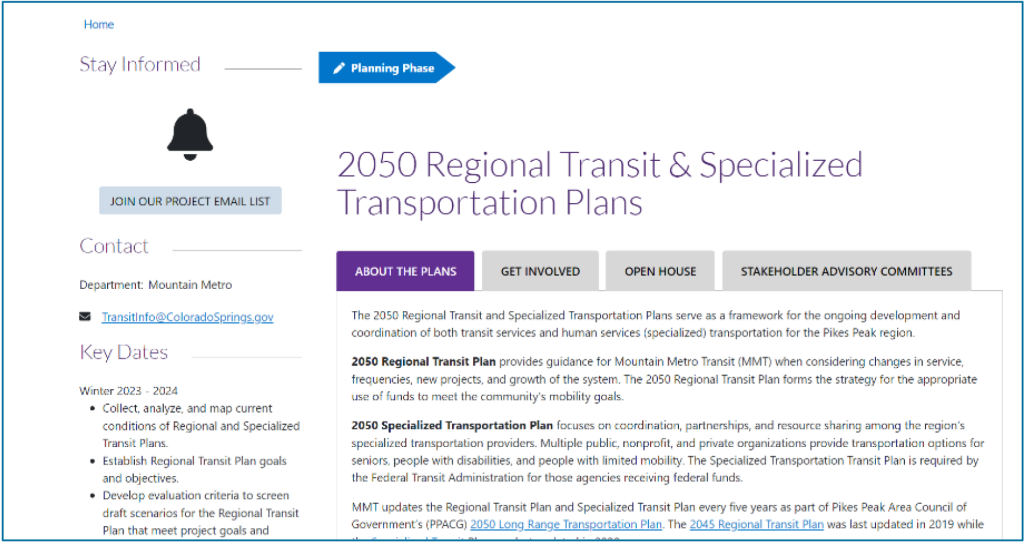
MMT provided the community with up-to-date digital materials throughout the planning process. The project team maintained an updated website (Figure 4) to educate stakeholders and the community and promote upcoming engagement opportunities. Throughout the study, the website had 3,177 visits from 2,532 unique users. Peaks in website views corresponded with the plan’s public open house.
In addition to the plan’s website, the project team utilized public e-blasts and MMT’s social media channels to inform and educate the community on study updates and upcoming events. The MMT email database utilized those who had previously subscribed to ConnectCOS and PlanCOS updates with an option to update their email subscription settings.
Figure 4. Website for Digital Engagement
Key Feedback Themes
Throughout the 2050 RTP and CHSTP process, the following themes emerged as consistent priorities of community members, current riders, stakeholders, and specialized transportation providers.
2050 RTP Priorities
Through various means of engagement, community members reacted to the seven proposed elements of the 2050 RTP. The vision objectives are unconstrained by cost and composed of multiple recommendations and strategies to expand service and introduce innovative technologies.
The public prioritized the following three proposed 2050 RTP recommendations in order of importance:
- Earlier/later service on all routes, which would expand service on all routes to begin at 6:00 a.m. on weekdays, 6:00 a.m. on Saturdays, and 7:00 a.m. on Sundays. Service would also be extended until midnight Monday through Saturday, and until 9:00 p.m. on Sundays.
- Investment in transit facilities, bus stops, and bus speed/reliability, which would include additional infrastructure to better connect bus stops, increase speed and reliability, and ensure on-time bus operations.
- Improved frequency on existing routes, which would include improvements to all existing routes to run at least every 30 minutes all day throughout the week.
This feedback was gathered through a digital polling questionnaire as well as an interactive in-person activity at the open house on Tuesday, April 30, 2024.
2050 RTP Feedback Themes
Stakeholders, community members, transit riders, and the public provided feedback on their current experiences and desires for a future transit system. The priorities align with feedback heard throughout the process, which focused on developing an aspirational, actionable, responsive, and funded plan to increase transit connectivity and operations. Throughout the process, the public expressed a desire to ride transit on the condition it was more convenient with improved infrastructure, such as bus stops, connected sidewalks, and bicycle-friendly amenities.
Additional key themes and feedback are summarized below.
Process
- Create a plan that is aspirational, actionable, and responsive to the region’s population growth and development.
- Identify community partnership opportunities to enhance transit services and operations.
- Explore funding streams to address transit and mobility gaps.
- Consider future transit planning with land use planning to improve the effectiveness of housing, access to essential services, and transit.
- Investigate ways to incentivize transit use.
Connectivity
- Connect transit to City and regional destinations, like the airport, higher education institutions, nearby jurisdictions, and military installations.
- Explore the option to connect to City and regional systems through light rail and passenger rail.
- Improve connectivity to Downtown Colorado Springs for pedestrians, cyclists, and transit riders, which allows them to seamlessly use all three modes.
- Ensure residents have access to transit when commuting to and from jobs to help grow the region’s workforce.
Operations
- Improve the accessibility and safety of bus stops and transfer locations.
- Expand service hours and frequency of service to attract additional ridership.
- Consider adding enhanced transit services on popular corridors, such as North Nevada and Colorado Avenue.
- Explore low-cost or free-fare travel on certain routes to increase ridership.
- Increase the salaries and benefits for bus drivers to attract more drivers to the industry.